“Deduction, Induction, and Hypothesis,” published August 1878, is the final installment of C.S. Peirce’s essay series “Illustrations of the Logic of Science.” It explains the difference between induction and making a hypothesis. Those two, plus deduction, make up the three main kinds of scientific inference.
Note: I have an annotated table of contents for my entire “cover band” reinterpretations of Peirce essays.
TL;DR
-
Induction and making hypotheses are different types of inference, though they’re often confused.
-
Induction infers properties possessed by a class of similar things from a sample of that class.
-
A hypothesis is formed in response to a surprise that demands explanation. It is a speculation about the circumstances in which the oddity will recur.
-
One way to see the difference between induction and hypotheses is to look at them as a reordering of the classical syllogism. Also as something like the implications of denying the conclusion of a syllogism.
-
Hypotheses tend to be bolder than induction but produce weaker belief. To strengthen belief, they must be used (deductively) to create predictions that are then tested. In contrast, induction is the testing.
-
This testing is a main source of new surprises and thus new hypotheses.
-
Science involves all of deduction, induction, and hypothesis.
-
Sciences are better differentiated by their techniques than by their subject matter. One factor is which types of inference they favor.
-
“Crucial” experiments are uncommon. Rather, science progresses by compounding evidence. By analogy, science is a strong rope formed by the weaving-together of many threads of evidence.
I. The plan
In a previous essay, I outlined the difference between the two terms “analysis” and “synthesis.”
-
Analysis moves forward from premises to conclusions, preserving truth (or the probability of truth) along the way. It does not create new truths, but rather reveals existing truths implicit in the premises.
-
Synthesis moves backwards from observations in order to strengthen or create new premises – previously unknown truths not implicit in previous premises. Unlike analysis, synthesis makes no promises that any inference is truth-preserving, though the probability of that can sometimes be bounded.
Synthesis can be divided into two types: “induction” and “hypothesis.”
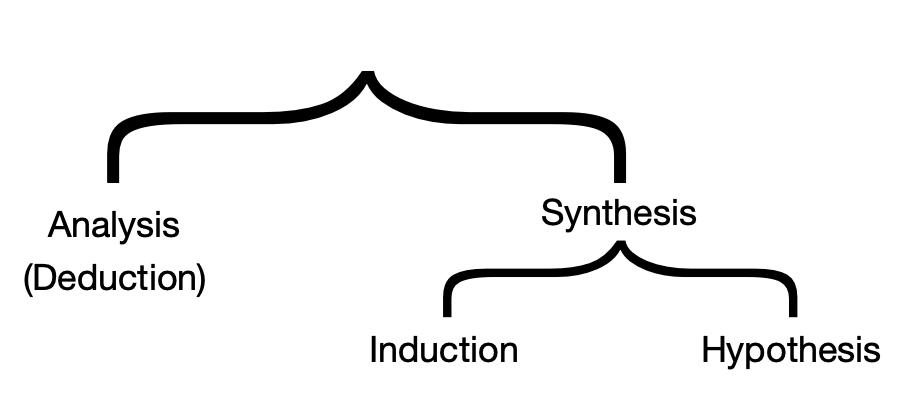
We’ve discussed induction somewhat, but hypothesis is a new form of inference.
I. Syllogizing
The syllogism form the mediæval logicians called Barbara looks like this:
- Rule.— All men are mortal.
- Case.— Enoch and Elijah were men.
- Result.— Enoch and Elijah must have died.
The general form is:
- Rule.— M is P.
- Case.— S is M.
- Result.— S is P.
Barbara is a purely deductive syllogism, and all deductive inference can be represented by Barbara.
This is only true, I think, for propositions of the S is P form. Peirce is not yet using De Morgan’s logic of relations as laid out in the latter’s “On the syllogism: IV and on the logic of relations” (1860). See Daniel D. Merrill Augustus De Morgan and the Logic of Relations (1990) for an exhaustive treatment that’s ridiculously expensive unless you’re married to an academic (hi Dawn!), in which case it’s a free PDF. US copyright law made sense in 1790 (14 years, renewable for another 14). It has since been co-opted by rentiers.
Some inferences are hard to follow in the Barbara form, so other forms are frequently used. For example, consider:
- All quadrangles are geometrical figures.
- No triangle is a quadrangle.
- ∴ Some geometrical figures are not quadrangles.
This can be recast in Barbara form like so:
- Rule.— All quadrangles are other than a triangle.
- Case.— Some geometrical figures are quadrangles.
- Result.— Some geometrical figures are not triangles.
Let me draw the Barbara syllogism, showing how inference flows from the rule through the case to the result.
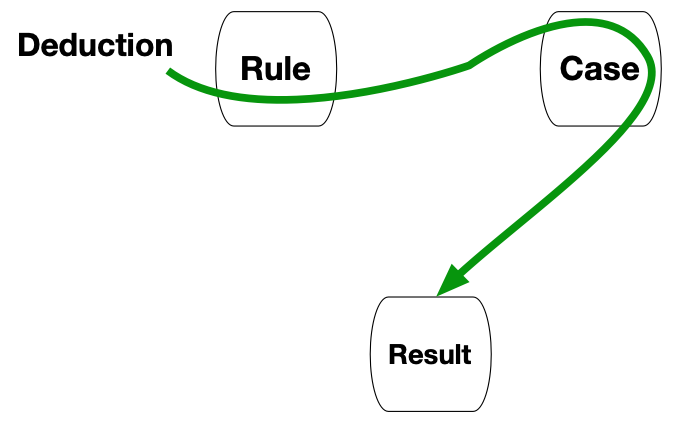
Inductive reasoning is more than applying a general rule to a particular case, so Barbara does not apply. We have to be careful here, though. The following looks somewhat like induction, but it’s just Barbara in disguise:
- Rule.— the beans in this bag are 2/3ds white.
- Case.— I just drew a handful of beans in such a way that, in the long run, the ratio of white to black beans will be equal to the ratio of the beans in the bag.
- Result.— these beans have been drawn in such a way that, in the long run, the beans drawn out will be white 2/3ds of the time.
Instead, induction “rows upstream” against the flow of premises. We observe a result in a certain case and from it deduce the rule, such as:
- Result.— All the beans in my hand are white.
- Case.— The beans in my hand were in the bag.
- Rule.— All the beans in the bag were white.
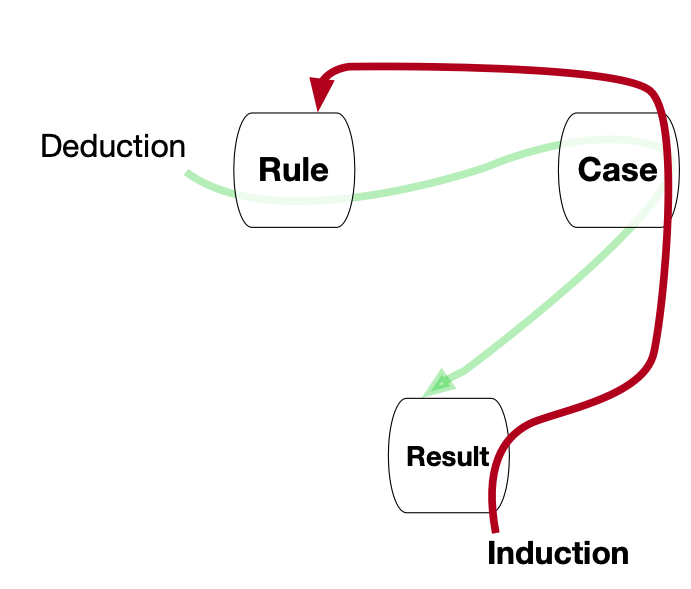
However, there’s another transformation of this three-step syllogism:
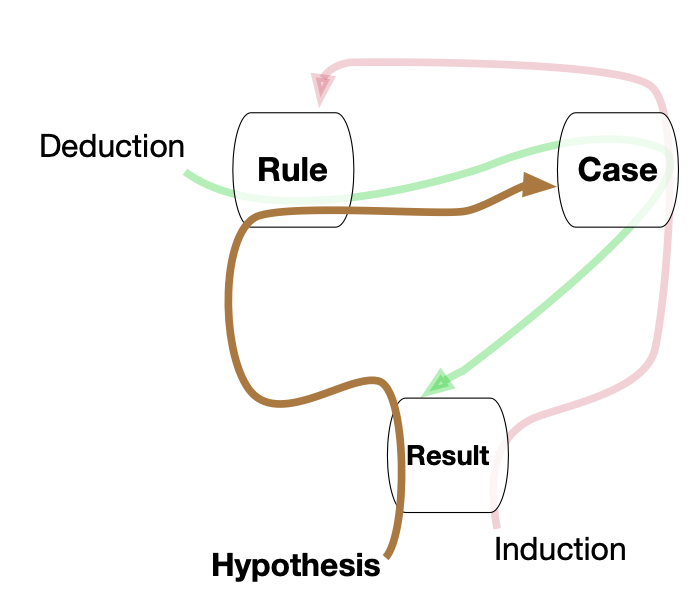
Consider entering a room that’s full of bags of beans. On the table, there’s a handful of white beans. After some search, I discover one of the bags is entirely full of white beans. I at once infer that it’s a fair guess, or probability, that the beans on the table came from that particular bag. That inference has this form:
- Result.— All the beans on the table are white.
- Rule.— All the beans in this bag are white.
- Case.— The beans on the table are from this bag.
Summary
There are three paths through Barbara that make up three inferences:
| Deduction | Rule and | Case give | Result |
| Induction | Result(s) and | Case give | Rule |
| Hypothesis | Result and | Rule give | Case (or explanation) |
Deduction:
- Rule.— All the beans in that bag are white.
- Case.— These beans are from that bag.
- Result.— These beans are white.
Induction:
- Result.— These beans are white.
- Case.— These beans are from that bag.
- Rule.— All the beans in that bag are white.
Hypothesis:
- Result.— These beans are white.
- Rule.— All the beans in that bag are white.
- Case.— These beans are from that bag.
II. What is hypothesis for?
Hypothesis happen when:
- We observe something weird,
- we create a hypothesis that would explain the weirdness,
- and we adopt the supposition that the hypothesis is true.
Or:
- we find that find that two objects share some properties in common,
- so we suppose that they resemble each other in other (enumerated) ways.
Examples
-
In August and September of 1870, I was scouting observation sites for the eclipse of 22 December of that year. (I chose Sicily.)
I happened to be in a Turkish province, and I met on the road a horseman who had four surrounding horsemen supporting a canopy over the first’s head.
I could think of no one but the governor of the province who would travel with such honor, so I hypothesized that the pampered horseman was he.
-
Fossilized fishes are found in an area far from the ocean. How can this be explained? We hypothesize that the area must have been underwater in the distant past.
-
There are numerous documents and even monuments to a conquerer said to be Napoleon Bonaparte. It is a reasonable hypothesis that such a man existed.
Hypothesis is a weak form of inference. We often get from it only a slight inclination toward belief. Yet such weak belief differs only in degree, not in kind, from our strongly-held hypothesis that events we remember from yesterday (a result) actually happened (a case or explanation).
III. Synthesis produces stronger claims but weaker beliefs
Let’s return to our Old Testament prophets:
- Rule.— All men are mortal.
- Case.— Enoch and Elijah were men.
- Result.— Enoch and Elijah were mortal.
If we choose to deny the result but retain the truth-preserving character of deduction, we must deny either the rule or the case (or both).
Denying the result but accepting the rule is the syllogism form called Baroco. It is made logically equivalent to Barbara by denying the case:
- Denial of result.— Enoch and Elijah were not mortal.
- Rule.— All men are mortal.
- Denial of case.— Enoch and Elijah were not men.
That last line looks rather like a hypothesis used to explain the oddity of Enoch and Elijah being taken up bodily into Heaven, but it’s not really an explanation. Okay, it is deductively guaranteed that E&E weren’t men, but what were they? We want a more specific, positive hypothesis about them.
Hypothesis is similar to, but stronger than, Baroco. That strength comes at a cost: we lose certainty in exchange for specificity (and testability).
The syllogism form dubbed Bocardo denies the rule instead of the case, giving us this:
- Denial of result.— Enoch and Elijah were not mortal.
- Case.— Enoch and Elijah were men.
- Denial of rule.— Some men are not mortal.
This looks a lot like induction from two cases but, again, the conclusion is timid and shies away from any new (“amplificative”) truth-claim. What’s special about those two men? We can’t use this syllogism to reason about the mortality of any particular people going forward.
Things get worse when inferences are probable, rather than certain. We know this:
- The truth of a premise makes the conclusion probable.
But we do not therefore know this:
- The falsity of a conclusion makes the falsity of the premise probable.
We might have just happened to pick one of the false cases of the conclusion. So, if science is to rely on statistics, as it increasingly must, this negation-based connection between synthesis and analysis gives us no particular guidance going forward.
However, it’s worth bringing up because it helps sharpen what we’re doing in synthesis:
-
When we adopt a hypothesis, it’s not just because it will explain the observed facts, but also because we think a contrary or competing hypothesis wouldn’t lead to such facts.
-
When we make an induction, it’s not just because it explains the distribution of properties in a sample, but because we believe a different rule would probably have led to a different distribution.
IV. Hypothesis produces stronger claims but weaker belief
Consider the following puzzle:
We discover a half sheet of paper with writing on it and a ragged edge where it was ripped from a full sheet. We suspect, for whatever reason, that the author is a certain person, M. F___. His desk is always locked, and he has the only key. Taking that key, we open the desk and find a half-sheet of paper. Its ragged edge fits the first half-sheet, and sentences that begin on one half-sheet are finished on the other, making them complete and comprehensible.
We infer that M. F___ wrote on, then tore, a sheet of paper.
Is this induction or hypothesis?
It may seem to be induction because surely the conclusion rests, in some sense, on our experience of ripping paper and seeing that the two halves have matching irregularities.
However, induction is about repetition of properties. Our history of observing ripped papers teaches us only that irregularities will match between half-sheets. What it allows us to predict is that if we examine the two half-sheets in question (or other pairs), we’ll find more examples of how they match, perhaps at smaller and smaller scales.
The hypothesis that M. F___ is the owner is a bolder leap than induction warrants – which is characteristic of hypothesis. Because of that boldness, hypotheses are typically tested in a rigorous way.
-
The hypothesis should be combined with existing facts in order to make predictions via a deductive procedure. For example, Newton’s laws can be combined with the facts of a pendulum (that it has an arm, connected to a pivot point, that constrains the motion of the bob) to deduce a formula predicted to describe the period of a pendulum.
-
We must avoid making only predictions for which the hypothesis is already known to work. Their confirmation tells us nothing new.
-
We will test each prediction multiple times – this is required both because of inevitable measurement error and because some particular observational setup may produce spurious results. So the more different the setups, the better we feel about the results. (Note that this testing has the aspect of induction: multiple attempts to observe a property, leading to an inference about all possible such attempts.)
-
Both the failures and successes of the predictions must be honestly reported. The whole procedure must be unbiased.
It is thought by some, such as the inhabitants of our legal system, that truth comes from bias contending with counter-bias, that the journey to belief requires hot and partisan debate. As argued in the first essay, such methods – incorporating obstinance, authority, and reasoning that begins with the desired conclusion – are not conducive to lasting belief. A sincere desire to know what the fact of the matter is produces longer-lasting, more robust beliefs.
-
It is to be hoped that observations will produce new surprises that will require new hypotheses. Thus does science advance. For example, one might be caging rodents for various purposes and happen to notice that younger ones housed with older ones start showing signs of senility. One might spin hypotheses for an explanation. Older rodents are known to teach younger ones; perhaps they’re somehow teaching them to act senile? Rodents eat each others' feces; perhaps the younger rats are being infected with the older rats' senility? From these hypotheses, experiments can be designed and this unexpected oddity can be explained. It’s gut microbes. It’s always gut microbes. I mean to someday write a blog post on this neat series of experiments and how they patiently worked through the question. In the meantime, here’s a transcript of an interview and the full paper (not paywalled).
In the case of M. F___, we could use our existing knowledge to predict he is engaged in some surreptitious enterprise – probably criminal – where his half of the note will serve to identify him to some counterparty. A search of his bank accounts might strengthen our suspicion that he wrote the note (and that he’s a crook), as could handwriting samples, interviewing the manservant that M. F____ claims must have been responsible, and so on.
V. A mixture of techniques
Induction and hypothesis are distinct:
-
Induction reasons from particulars to a general law.
-
Hypothesis reasons from effect to cause.
Usually, the difference is clear, though there are ambiguous cases. In any event, all three types of inference (including analytical deduction) will be used in any extended episode of science. The kinetical theory of gases gives an example.
Quite a long time ago, Mr. Boyle developed, from observation, the law that bears his name. It states that if you double the pressure on an enclosed volume of gas (for example, by adding weight to a piston pressing down on a cylinder), the volume will halve. The formula is PV=k, where k is a constant that depends on the temperature and amount of gas.
Such empirical formulae rest entirely on induction, and they are of low status in science because they lack a mechanism, a “why.”
In 1738, Daniel Bernoulli proposed a hypothesis: the kinetical theory of gases. He claimed all gas is composed of very small particles separated by great distances compared to their diameters, moving with great velocity. As a result, what prevents a piston in a cylinder from crashing all the way down is that innumerable such particles are crashing against its bottom so as to equalize the upward and downward forces.
When the downward pressure is increased, the particles have less distance to travel before they hit the bottom of the cylinder, so the increasing number of collisions at some point again balances the downward pressure.
Bernoulli’s explanation found little favor, partly because both the law of conservation of energy and the nature of fully elastic collisions were unknown. Moreover, it made certain assumptions that were dubious:
- That gas particles are so small that reducing the volume won’t change how often they bounce off each other.
- That the gas particles are independent: they neither attract nor repel each other. But might it not be that particles repel each other, in which case piston pressure might be akin to pushing two opposing poles of two magnets together, and thus have no direct interaction with the piston?
Over time, Bernoulli’s theory achieved various experimental (inductive) results that supported it, but it only became fully accepted when it became tied to a different theory, the mechanical theory of heat. That theory also worked with small particles, and it also was inconsistent with the idea that gas particles greatly interact with each other. It was compatible with Bernoulli’s theory but had a tighter deductive connection with the well-understood theory of mechanics.
This illustrates a characteristic of science: it does not depend on “crucial” experiments so much as the gradual accretion of evidence. Scientific conclusions are like a rope: composed of multiple fibers, each of which is disputable, but solid and dependable in the aggregate.
Although I disagreed with Mr. Mill about uniformity and induction in the previous essay, he is correct that certain guidelines for synthetic inferences can be valuable. His ideas of agreement, difference, residues, and concomitant variations are useful, but they are not essential. It is the three forms of inference that are essential. Even without the heuristics, inductions and hypotheses can attain great force.
VI. People do this work
The distinction between deduction, induction, and hypothesis is not only logical but also psychological or even physiological.
| Induction | the habitual element of thought |
| Hypothesis | the sensuous element of thought |
| Deduction | the volitional element of thought |
Induction infers a rule. As discussed in the first essay, believing a rule means adopting a habit. That makes induction a logical rule that expresses the physiological process of forming a habit.
Hypothesis is in some ways analogous to listening to music. A variety of distinct sounds strike the ear and are synthesized into a single experience with emotional impact. In hypothesis, a complicated set of propositions about a particular topic are synthesized into a single conception – which has a similar emotional impact.
Deduction adds nothing to its premises but is a process of narrowing our attention to one or more of them. This is akin to the physiological experience of exercising will to accomplish a task.
VII. Kinds of people do this work
As we’ve seen, science involves all three inference techniques. However, different people will gravitate to one more strongly than another, and that affects the field of science they are most attracted to.
After all, what separates scientists more than anything else are the techniques (not just logical techniques) that they use. Techniques are the basis for categorizing the sciences.
Of the natural sciences, the classificatory sciences – systematic botany and zoology, mineralogy, and chemistry – are almost purely inductive.
The sciences that lean heavily on theory – astronomy, pure physics, and the like – are largely deductive.
Finally, there are the sciences of hypothesis – geology, biology, etc.
VIII. The stirring conclusion
If you attend to whether you’re making a hypothesis or performing induction, rather than confusing the two as so many do – I can promise you that you’ll find various advantages flowing to you.
Liner notes for the 2026 reissue
My description of Peirce’s idea of the scientific method is more complete than what he presented in the essay, but I think it’s fair to his later writings.
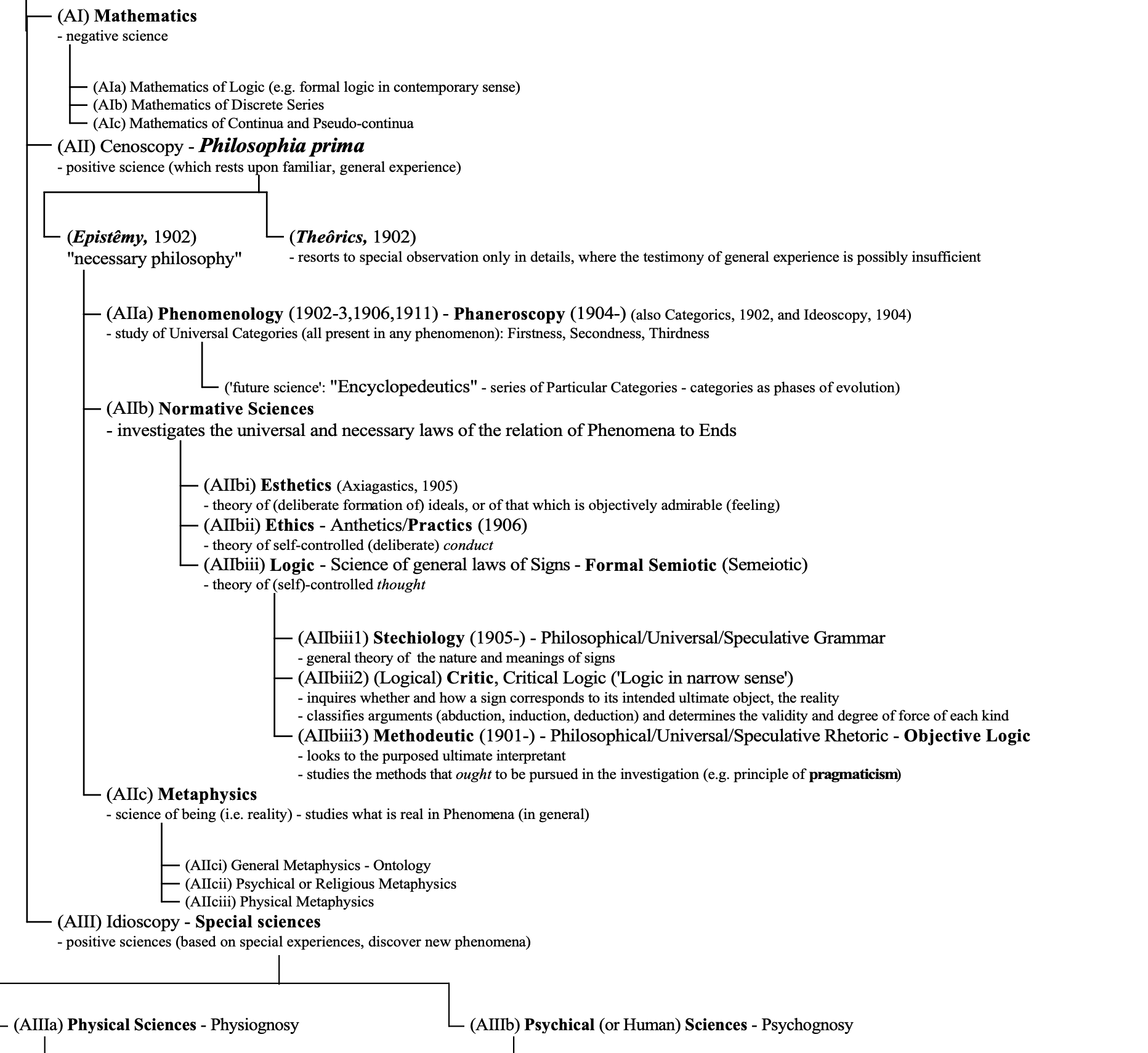 Click to enlarge in a new tab.
In the next-to-last bit, Peirce points toward a classification of the sciences (broadly construed to include mathematics and philosophy as well as the natural and human sciences). In the right margin, I show a part of Tommi Vehkavaara’s outline. If this series finishes before my life does, I’ll write up something like Peirce’s “Philosophy and the sciences: a classification.“ In Justus Buchler (ed.), Philosophical Writings of Peirce, 2001 (archive.org).
I’ve written exhaustingly about the critical rationalists (Popper, Lakatos, etc.) Peirce’s approach is not dissimilar:
- Hypotheses are not arrived at deductively nor inductively.
- Predictions are made via deductive logic (though Peirce is much more explicit that they involve adding facts from outside the hypothesis to the hypothesis and deriving predictions from the mix).
- Predictions should be novel – no fair predicting what you already know will happen.
There are some key differences that, I think, stem from an underlying worldview that I’ll boil down to Peirce’s comfort with uncertainty.
Peirce was a practicing scientist. He measured local gravity (g) with pendulums, some of his own design. He observed double stars and solar eclipses. He wrote a report on the shape of our galaxy and another that tied the meter to the wavelength of light. He measured, which taught him that imprecision is inevitable and is more a property of reality than a sign of inadequate technique. See Robert P. Crease, “Charles Sanders Peirce and the first absolute measurement standard,” Physics Today, December 2009, for a survey of Peirce’s measurement activities. Crease describes this essay series as “betray[ing] the influence of his scientific work and his metrological experiences in particular, which allowed him to appreciate features of science that eluded – and still elude – those with a more formalistic outlook.”
His handling of certainty – the desire to say that a claim is true – is more practical than Popper’s:
-
Both agree that induction does not produce certainty. Popper (over)reacts by removing induction from respectable science. Peirce reacts by looking at how induction can nevertheless be used.
-
Both agree that science in general cannot produce certainty, only provisionally-held belief. Popper concentrates on a remaining source of certainty: the crucial experiment that refutes a hypothesis once and for all. Peirce, I think, doesn’t believe in certainty of refutation any more than he does in certainty of confirmation. In particular, measurement error and other sources of varying observations of experimental results require repetition to increase belief that a refutation has happened. Thus refutations surreptitiously depend on induction.
-
Popper copes with the discomfort of a lack of certainty (a lack of belief) by producing a methodology one should be certain is correct. So the irritation of un-belief is soothed when the scientist knows he’s engaging in right behavior. Peirce copes by hoping that a community of inquiry will, given sufficient time and effort, converge on the truth. That is, a claim which no one can ever see any remaining reason to challenge is satisfactorily certain.
-
Popper hives off creativity into hypothesis-generation. Great Men, who have some ineffable ability to intuit truths, are not subject to procedures or philosophizing. Peirce locates creativity in communities, and thinks that creativity is surely a topic of philosophy, even of ontology.
-
Popper is very skittish of statistics, eventually saying they offer the scientist only “risky decisions.“ See Cosma Shalizi’s blog post “Deborah Mayo, Error and the Growth of Experimental Knowledge.” That’s of no practical use. Peirce gets on with figuring out statistical logic and practice. He and Joseph Jastrow conducted an experiment that was an early use of repeated measures design and some have said “introduced blinded, controlled randomized experiments (before Fisher).” (I think that’s a stretch, but it was a big step in that direction. So many claims that “This was the first time” are shaky. Firstness is a fuzzy concept.)
And I can’t resist a character judgment. Of Popper, Stephen Thornton writes “Popper’s commitment to the primacy of rational criticism was counterpointed by hostility towards anything that amounted to less than total acceptance of his own thought.“ Thornton, Stephen, “Karl Popper,” The Stanford Encyclopedia of Philosophy (Fall 2026 Edition). He frequently advertised his certainty in himself.
In contrast, Peirce wrote that the highest praise he had ever received was “meant for blame. It was that a critic said of me that I did not seem to be absolutely sure of my own conclusions.“ Buchler, p. 3. Italics Peirce’s.
Both Popper and Peirce were difficult people, but Peirce is more to my taste because he more often practiced what he preached in writings like “The scientific attitude and fallibilism” (circa 1896). Buchler, pp. 42-59.