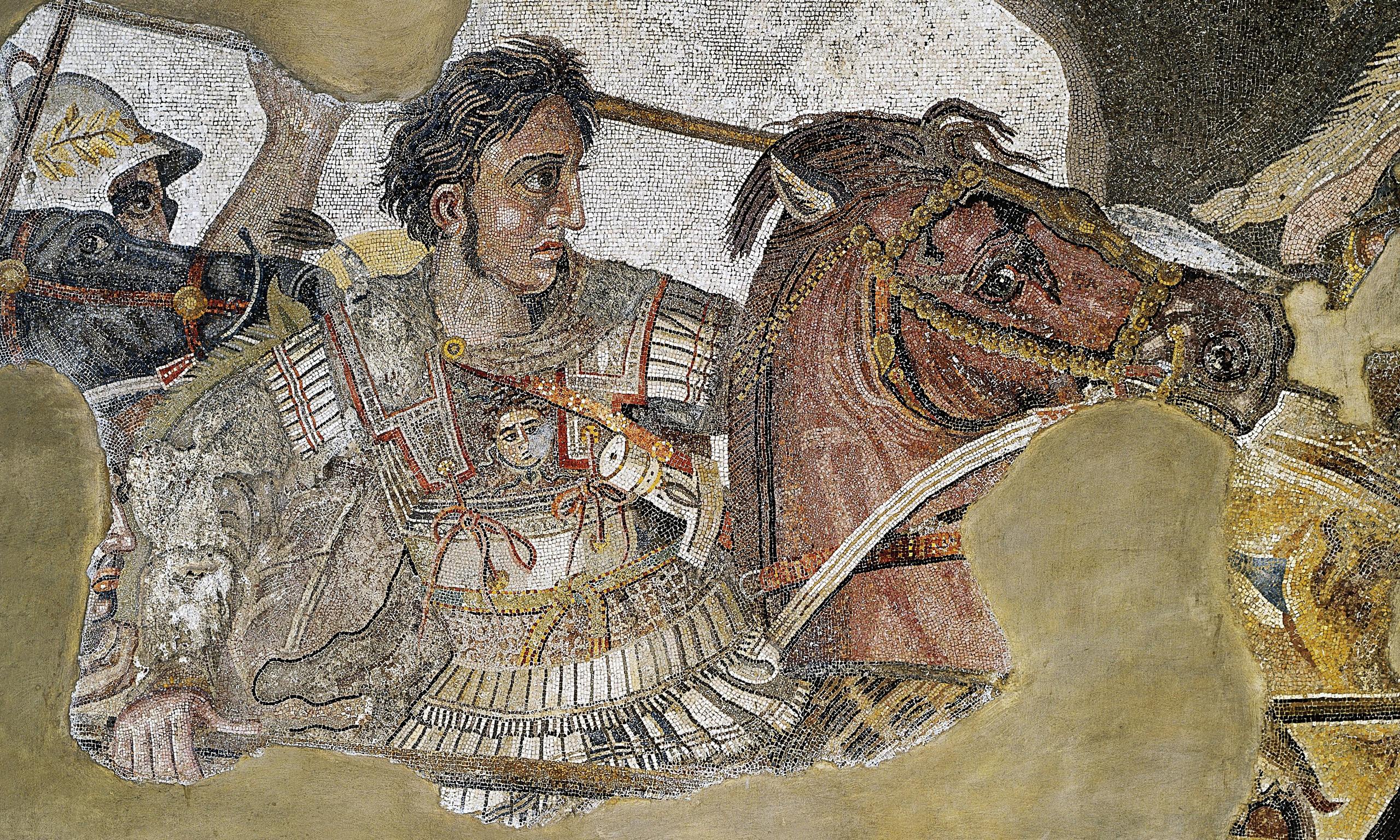
The image is of Alexander the Great. He won a lot of battles, aided by other soldiers, most notably his heavy cavalry (the Companions).
The critical rationalists are like historians who focus on the Great Men of history. When they see the history of science, they see the Alexander-equivalents – the Newtons, the Einsteins. They are uninterested in the common soldiers, and mostly uninterested in the scientific equivalent of the Companions. They do not see the full mosaic with all its participants:

Thus – like Great Man historians – they miss a lot.
About this series – Sorry there’s no picture of Mt. Fuji, but the images above were too good not to use.
Here are some quotes:
“Why is Kuhn concerned to up-value Normal Science and down-value Extraordinary Science? This question is prompted by several considerations. First, Normal Science seems to me to be rather boring and unheroic compared with Extraordinary Science.” – John Watkins, “Does the Distinction Between Normal and Revolutionary Science Hold Water?”, Criticism and the Growth of Knowledge, 1970, p. 31.
“One has to appreciate the dare-devil attitude of our methodological falsificationist. He feels himself to be a hero who, faced with two catastrophic alternatives, dared to reflect coolly on their relative merits and choose the lesser evil.” – Imre Lakatos, “Falsification and the Methodology of Scientific Research Programmes,” Criticism, p. 113.
“But these marvellously imaginative and bold conjectures or ‘anticipations’ of ours are carefully and soberly controlled by systematic tests.” – Popper, The Logic of Scientific Discovery, 1959, p. 278.
“But the newly rising structure, the boldness of which we admire, is seen by the conventionalist as a monument to the ‘total collapse of science’, as Dingler puts it.” – Popper, Logic, p. 61.
“Science does not rest upon solid bedrock. The bold structure of its theories rises, as it were, above a swamp.” – Popper, Logic, p. 94.
“Take Boltzmann: there are few greater scientists. […] But he was as far from a ‘normal scientist’ as anybody could be: he was a valiant fighter who resisted the ruling fashion of his day.” – Popper, “Normal Science and its Dangers,” Criticism, p. 54.
“To suggest such an idea required even greater courage than Prout’s; the idea crossed Einstein’s mind but he found it unacceptable, and rejected it.” – Lakatos, Criticism, p. 142.
“I believe that science is essentially critical; that it consists of bold conjectures, controlled by criticism, and that it may, therefore, be described as revolutionary.” – Popper, Criticism, p. 55.
I could go on, and I will, later.
Behold the scientist
The mass of common soldiers is vital to winning battles and wars, and I see no reason to ignore the role common scientists play in the big conflicts of scientific history. Recall that the critical rationalists adopt the philosophical habit (or conceptual metaphor) of comparing argument to conflict. You win intellectual battles by successfully attacking your opponent’s weak spot.
However, the critical rationalists think common scientists matter little to the progress of science. In fact, they are dangerous when they constrain the Great Men:
“Thus in Kuhn’s view scientific revolution is irrational, a matter for mob psychology.” – Lakatos, Criticism, p. 178.
“But the Kuhnian research programme contains a new feature: we have to study not the mind of the individual scientist but the mind of the Scientific Community. Individual psychology is now replaced by social psychology; imitation of the great scientists by submission to the collective wisdom of the community.” – Lakatos, Criticism, p. 179.
“In my view the ‘normal’ scientist, as Kuhn describes him, is a person one ought to be sorry for. […] I can only say that I see a very great danger in [the attitude of the such scientists] and in the possibility of its becoming normal (just as I see a great danger in the increase of specialization, which also is an undeniable historical fact): a danger to science and, indeed, to our civilization.” – Popper, Criticism, pp. 52-3.
I’ve already documented how limited is the role the critical rationalists allow to experimenters. But they talk even less about what I might call “minor theorists” – to the point that I don’t have an idea of what such people are supposed to do (except, I suppose, to work to become Great.)
An example
It’s characteristic of critical rationalist rhetoric that their stories skip nimbly from one scientific revolution to the next:
-
Newton published his theory of gravity in 1687.
-
There was a dramatic confirmation in the form of the successfully predicted return of Halley’s comet (predicted in 1705, observed in 1758). Critical rationalists differ in whether it’s rational to care about a flashy confirmation like that. (Lakatos says it is; Popper says not.)
-
The precession of the perihelion of Mercury is discovered in 1859. This violated a prediction (consequence) of Newton’s theory: that the axis of the ellipse Mercury traces around the sun will stay put. Turns out it doesn’t.
-
Nothing much happens. People don’t abandon 172 years of gravitation (as Lakatos points out) “Theories grow in a sea of anomalies, and counterexamples are merrily ignored.” – Lakatos’s lectures on scientific method in For and Against Method, 1999, p. 99. .
-
-
Einstein produces a replacement theory of gravity in 1916. Notably, it explains the precession of Mercury. There’s a problem here for critical rationalists in that predicting a known fact isn’t novel or bold. A later elaboration allows such to count if “the hard core of the programme was not devised to explain it.” That seems weak to me: “Professor Einstein, do you state under oath that you never thought about Mercury whilst devising your scheme?” But Einstein gave two other bold predictions, so the point is moot.
What’s missing is anything anyone else did with Newton’s theory in the 220 years between Newton and Einstein. Consider the pendulum’s equation of motion. I think it’s an interesting case because it:

-
… introduces two new entities to the Newtonian theory: the idea of a pivot point, and the distance from the pivot to the mass in question (the bob), and:
-
… uses Newton’s Laws to calculate a differential equation governing the motion of the bob, which unfortunately:
-
… is hard to solve. However, given an approximation that has negligible error given amplitudes of less than about twelve degrees, there’s a closed-form easy solution, which:
-
… supports Galileo’s earlier observation that a pendulum’s time-to-swing (period) is independent of how much you pull back the bob before you let it loose (amplitude).
So we have two new entities, one new equation, one approximation, and one significant piece of background knowledge explained (the independence of period). How does this fit in? It seems something that could be included in Newton’s overall theory or research programme. But where’s the refutation that prompts the addition? And does this new equation predict something new? We already knew about the constancy of the pendulum’s period.
This pendulum work is outside the critical rationalist methodology. It’s “puzzle solving,” which Popper looks down on:
“I do not know whether Kuhn’s use of the term ‘puzzle’ has anything to do with Wittgenstein’s use. Wittgenstein, of course, used it in connection with his thesis that there are no genuine problems in philosophy — only puzzles, that is to say, pseudo-problems connected with the improper use of language. If you’re interested in intellectual gossip with an admixture of serious topics, Wittgenstein’s Poker: The Story of a Ten-Minute Argument Between Two Great Philosophers (Wittgenstein and Popper) is an entertaining read. The incident described (Wittgenstein supposedly threatening Popper with a fireplace poker) predated what Popper wrote here. However this may be, the use of the term ‘puzzle’ instead of ‘problem’ is certainly indicative of a wish to show that the problems so described are not very serious or very deep.” – Criticism, p. 52, footnote 1.
Did Alexander the Great solve puzzles? Or did he conquer?
Cutting the Gordian knot
Well, actually, Alexander did solve puzzles. (Or were they problems by virtue of being worthy of his attention?) Famously, he solved the Gordian Knot with a bold stroke (literally: a stroke of his sword.)

That image has appealed for centuries. Why? I think it’s Alexander’s quickness, decisiveness, and ability to just resolve the issue after all these years. “Let’s move on!”
(Would you watch a movie that showed Alexander patiently untying the Gordian knot over a period of several months?)
Part of the boldness the critical rationalists exalt is the ability to “strike to the heart of the matter,” to solve problems in a way lesser men were unable to see because of their timidity or lack of imagination.
I think it reasonable to say that Alexander’s solution to the Gordian Knot is simpler than the alternative. (After all, the expected solution – untying the knot – was so difficult no one had accomplished it.) But “simplicity” is another of those essentially contested concepts that no one will ever agree on.
Popper has a chapter on simplicity in The Logic of Scientific Discovery. He is not interested in different definitions of the word: “Nothing depends on the word ‘simplicity’: I never quarrel about words, and I did not seek to reveal the essence of simplicity.” – Logic, p. 131, addendum to the 1972 edition. (Good for him!)
What Popper is interested in is describing the underlying properties theorists are referring to when they say “this theory is simpler than that one.” He seems to claim that the more testable theory is simpler,
He equates greater testability with “greater empirical content,” which means “they tell us more” – Logic, p. 128. and that such a simplicity is measured (approximated?) by the number of free parameters in equations. That is: consider some number of observed data points. There are an infinite number of equations that match (predict) those points. Of those equations, f(x, y) is simpler than f(x, y, z).
I have a hunch that the critical rationalists' dislike for scientific fields that rely heavily on statistics (agronomy, social science) is partly that there are so many potentially-relevant variables that the scientists just give up and define an error or noise term that represents those variables. Thus they’re hiding within a single parameter many parameters they ought to be accounting for.
Because the critical rationalists are focused on formal languages (logic, mathematics) as the sine qua non of rationality, they tend to characterize theories in terms of the number of statements or equations:
“At the heart of any research programme is a ‘hard core’ of two, three, four or maximum five postulates. Consider Newton’s theory: its hard core is made up of three laws of dynamics plus his law of gravitation.” – Lakatos, For and Against Method, p. 103.
I think it’s better to think of the entities (or nouns, or parameters) in a theory. Newton’s research programme is better described as being essentially a set of entities like “force,” “mass,” and “acceleration,” together with the equations that link the terms together. That meshes with Popper:
“The new theory should proceed from some simple, new, and powerful unifying idea about some connection or relation (such as gravitational attraction) between hitherto unconnected things (such as planets and apples) or facts (such as inertial and gravitational mass) or new ‘theoretical entities’ (such as fields and particles).” – Popper, Conjectures and Refutations (5/e), p. 241, his emphasis.
The result is that adding the the entity (parameter) called “pivot point” to Newton’s theory complexifies it in an unaesthetic way. Consequently, psychologically, it makes the aggregate theory less appealing. The physicist Paul Dirac, who linked aesthetics tightly to truth, pointed out that Einstein’s general relativity is substantially more complicated than Newton’s theory but was still preferable because of its mathematical beauty. P.S. There’s an interesting podcast episode on Dirac. I would not have guessed he was trained as an engineer.
From this point of view, Great Scientists invent simple theories that lesser scientists then complexify with pendulums and pivot points and whatnot. The critical rationalists look away from that process because of their aesthetic preferences. They don’t talk about how the theory of the pendulum adds onto what Lakatos calls the “hard core” of a research programme.
Alexander didn’t cut the Gordian Knot and then fuss around looking at the relationship between sword strokes and different kinds of knots. He moved on. Methodologists of Great Men aren’t interested in what and who gets left behind to deal with the details.
Marxism again
 Click to enlarge.
Just as they seem uninterested in the theoretical events between the Newton of 1687 and the Einstein of 1916, they seem uninterested in the theoretical events between 1848 and 1917. That is – I claim – in part because they are biased to focus on the earliest expression of a Great Man’s theory; that is, on what Marx wrote circa 1848.
Marx made two bold predictions that I’ve discussed: the continued immiseration of the proletariat and the origin of the European revolution in the most advanced nations. He later complicated those predictions, apparently because he was trying to explain why the revolutions of 1848 fizzled. Marx adjusted his theory of immiseration and added a preliminary step (revolution in Russia) to his theory of history. The revolution was supposed to start in Russia, but that event was in turn supposed to prompt revolutions in the more advanced nations, who would then help Russia out as part of a pan-European revolution.
This is actually decent science in critical rationalist terms. A natural experiment (the failed 1848 revolutions) indicated problems in the theory. The theorist adjusted the theory and made two new predictions (if they’re savvy enough, the bourgeoisie can buy off the proletariat; and the revolution is most likely to happen in Russia because that’s the most vulnerable state.) Both predictions arguably proved out.
But if you skip 68 years of natural experiments and insist that history is a sharp revolutionary leap from one bold, simple theory to another, it’s easy to miss what actually happened. “Reality is that which, when you stop believing in it, doesn’t go away” – Philip K. Dick. Except that I’d replace “stop believing in it” with “stop paying attention to it.”
 Who's responsible if a small child drowns in this pool?