The critical rationalists have the intellectual habits of philosophers. That biases their judgment of science and gives them a blinkered perspective on what scientists should be doing.
In this post: conflict as the path to truth confidence.

Sociologist Randall Collins provides the epigraph for this post: The Sociology of Philosophies: A Global Theory of Intellectual Change, 2009, p. 728.
In the field of fundamental issues which is philosophical turf, creativity is tightly focused conflict boring in on problems until deep faults are found; around these reconceptualization takes place. In this sense Popper accurately recognized in falsification something central to intellectual life – perhaps not in actual histories of scientific discovery, but in the world of the philosophers that surrounded him.
Let’s explore that and see how that biases the critical rationalists' judgment.
Truth
The critical rationalists, being philosophers, are oriented toward truth. They want to speak true statements. The goal may be unachievable, but they still bend their efforts in that direction.
Traditionally (since Socrates), statements are about lofty concepts like temperance (Charmides), law (Minos), rhetoric (Gorgias), language (Cratylus), the Good (Philebus), justice (Crito), and so on.
These statements are universal. A true statement about language, say, would apply to all languages and all uses of words. Specific statements (“Children playing with puppies is an example of the Good”) are not of interest except insofar as they shed light on universal statements.
Scientists are presumed to have the same goals: to make universal claims about observable things (and processes) out there in the world. Such as this truth-valued claim: “Intestinal interoceptive dysfunction drives age-associated cognitive decline.” Specific observations such as “[We saw] Hydrallantois in a caprine doe” are not of interest unless they prompt further work that yields universal statements.
That is, Darwin’s eight years of concentrated work dissecting barnacles would not be valuable (to the critical rationalists) if it merely led to “a 4 volume monograph on the Cirrepedia, living and extinct – the authoritative text on barnacles then and probably still now.“ From “Darwin’s Barnacles.” Rather it’s valuable because “far from being merely a dry, taxonomic exercise, [it] was a highly theoretical work that addressed several problems at the forefront of contemporary natural history.“ From “Darwin’s Study of the Cirripedia.” This essay says the work was valuable for multiple reasons: as a standard reference work, as a way of perfecting Darwin’s understanding of taxonomy (both theoretically and technically), and for giving him a reputation as someone who sweats the details. That latter added credibility to his later claims about natural selection, ad hominem fallacy be damned.
This emphasis on universal statements means that the essence of science is the scientific theory, not experiment or observation.
Argument
At its worst, philosophy is something you do against an opponent. Your job is to take the most mean-minded interpretation you can of the other person’s view and show its absurdity. And repeat until submission. Philosopher Jonathan Wolff, quoted in Chris Bertram, “Against (most) aggression in philosophy.” I like the ambiguity: by “submission,” is he referring to submitting a paper? Or to the opponent submitting to your attack?
The philosophical tool for approaching closer to truth is argument, Collins' “tightly focused conflict boring in on problems until deep faults are found.” That’s hardly unique to philosophy, but Collins argues – drawing on the history of Chinese, Japanese, Indian, European, and American philosophy – that philosophy is where the “Argument is War” conceptual metaphor fits best.
I speculate that philosophers are given to parasocial relationships with philosophers in their academic lineage. (Collins has much to say about such lineages – 881 pages worth, before appendices, endnotes, and indices.) So when a Kantian philosopher sees a utilitarian attack Kant’s ethics, it’s likely to get personal.
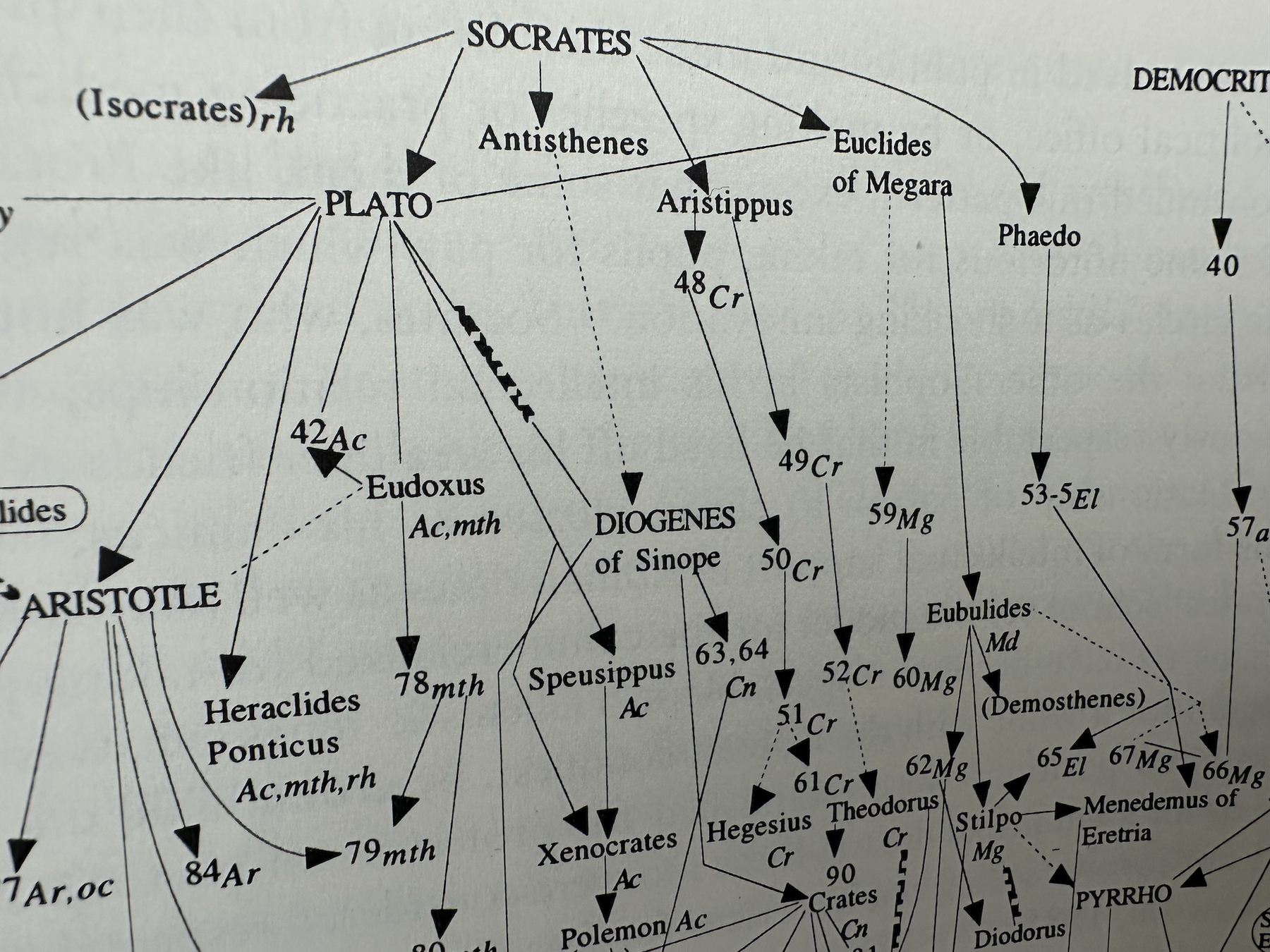 Some philosophical lineages. (Click to expand in a new tab.)
If the standard philosophical move is to attack a theory (ideally, even including your own), the same should be true of science. That is, forcing theories to change is the most valuable work a scientist can do. Some of that argumentation can be done at a purely theoretical (or logical) level. For example, the Bohr “solar system” model of the atom was criticized because it contradicted Maxwell’s equations of electromagnetism (as had some previous models).
Popper’s innovation was to focus on the experiment as an ally in the attack. Unlike in (most) philosophy, the physical world gets a say. That’s what experiments are for: to produce a credible counterexample to a universal theory, which the originator of the theory should use to make it stronger (to have more “empirical content”). Popper places great emphasis on the theorist making predictions to be checked by experiment, but I don’t see that it makes a difference if the prediction was made by someone else (like the experimenter) or even if the refutation is discovered by accident.
Lakatos differs from Popper in that he cares about confirmations, at least those of “bold” or “risky” predictions. As far as I’ve seen, Popper allows confirmations to play two roles. The first is moral support: “We need the success, the empirical corroboration, of some of our theories, if only in order to appreciate the significance of successful and stirring refutations.” The second is to help in “attributing our refutations to definite portions of the theoretical maze.” Both quotes from Karl Popper, Conjectures and Refutations: the Growth of Scientific Knowledge) (5/e), 1989, p. 243. I think it’s fair to think of those confirmations as attacks on a rival theory – to show it cannot predict what was just confirmed. Lakatos is fond of recounting how successful predictions force doubters into retreat. (He takes glee in how the French Academy was forced to give up on their opposition to Newton’s theory of gravitation when Halley’s comet appeared as predicted.) For and Against Method: Including Lakatos’s Lectures on Scientific Method and the Lakatos-Feyerabend Correspondence, Motterlini (ed.), 1999, p. 99.
So?
“Intestinal interoceptive dysfunction drives age-associated cognitive decline” is a really interesting result from a series of experiments prompted by the question “Why are young mice housed with old mice ‘infected’ with the old mice’s weak memories?” The story of that research seems to be an example of something attributed to Isaac Asimov: Quote Investigator, as usual, ruins everything. There’s no evidence Asimov said it.
The most exciting phrase to hear in science, the one that heralds new discoveries, is not “Eureka!” but “That’s funny …”
The researchers wanted to know what was up with those mice, so they found out. They weren’t testing any theory in an attempt to refute it – or to confirm it, for that matter. They just did what the majority of scientists do: use theories to answer questions.
In a fairly detailed interview with the paper’s corresponding author, the interviewer says, “This is a study where, as I was reading it, I kept writing, ‘This is wild,’ in the margins.“ “Could boosting gut–brain communication prevent memory loss? A tale of microbes, memory, and our internal senses,” an interview with Christophe Thaiss. The link given is to a transcript, which is quite readable. The “this is wild” comment is at minute ~06:05. The critical rationalists wouldn’t have agreed, I think, because the study is merely what Thomas Kuhn called “normal science.” Which they didn’t care for. John Watkins: Criticism and the Growth of Knowledge, 1970, p. 27. (Full text.)
But I shall consider [Kuhn’s The Structure of Scientific Revolutions] from a methodological point of view, and methodology, as I understand it, is concerned with science at its best, or with science as it should be conducted, rather than with hack science.
and: ibid, p. 31.
Why is Kuhn concerned to up-value Normal Science and down-value Extraordinary Science? […] First, Normal Science seems to me to be rather boring and unheroic compared with Extraordinary Science.
Popper’s contribution to the same volume is titled “Normal Science and its Dangers.“ ibid, pp. 51-58. Quote is from p. 53. As I’ve mentioned before, he’s scathing:
The ‘normal’ scientist, as described by Kuhn, has been badly taught. He has been taught in a dogmatic spirit: he is a victim of indoctrination. […] I can only say that I see a very great danger in it and in the possibility of its becoming normal […]: a danger to science and, indeed, to our civilization.
I disagree. I think his vision of science is plodding and crabbed and – as an exclusive interest – only attractive to unattractive personalities. More importantly, it draws attention away from the world. Consider the critical rationalists' reaction to the facts of missing immiseration or the unexpected (to them) Russian revolution. Was it “that’s funny…”? No. They didn’t delve into the phenomenon, just turned to attacking (what they thought to be) the relevant Marxist theory. So they seem foolish to someone who looks even shallowly into what really happened.
To the critical rationalists, natural – or planned – experiments aren’t for casting light on reality; their value comes from making simple statements about theory. They treat experiments in science the same as thought experiments in philosophy. That’s the topic of the next post. (Or possibly the post after next.)