Here’s another “cover version” of C.S. Peirce’s writing. I’m working from a three-paper series in The Journal of Speculative Philosophy (1868-69) that William James described as “exceedingly bold, subtle and incomprehensible […] They nevertheless interest me strangely.” Indeed, Peirce bounces from topic to topic in ways that I assume made sense to him but do not to me. So rather than treating each paper chronologically, I’ll do one post on each of the key topics.
This post’s topic: Peirce’s argument that we can reduce cognition to inference, particularly to deduction, induction, and abduction. In a way, this anticipates some forms of symbolic (“classic”) AI.
Here are the two papers I’m drawing from:
We now assume the voice of a modernized Peirce.
How does a fact come to mind? One way is that we perceive it in the world out there: “That elephant over there is grey.” Another is that we glean it from within our mind: “I am imagining an elephant, not seeing one.” Another is that we infer one fact from others: “I know that all elephants are the same color, and that elephant over there is grey, so I know (infer) that all elephants are grey.”
In this essay, I argue that experience shows us that we needn’t assume a unified act of perception: we can model all thought as inference and lose nothing. I’ll do that by showing that what we think of as a fact impressed upon us by perception can be explained as inference from other known facts.
I. Terminology, alas
Words like “thought” and “fact” are dangerously vague, so I’ll use “cognition” instead. A cognition is a proposition active in the mind.
-
A proposition is a claim – true, false, or probable – about some subject.
-
A subject is an entity or thing, concrete or abstract. Think of “subject” as like the subject of a sentence, a noun phrase like “that elephant over there,” “all elephants,” “the three-legged elephant on the left,” or “all female elephants.”
-
A proposition claims that the subject has or is a property (traditionally called a “quality"). Propositions connect (or “unite”) properties to subjects. Think of properties as adjective phrases like “grey,” “fond of hay,” “born under a bad sign,” or “a creature that is currently running.”
Philosophy has traditionally held that all true statements can be framed as propositions.
If you know the proposition “all elephants are grey,” but aren’t actively thinking about it, it doesn’t count as being active in the mind. In this essay, we’re not interested in whether someone knows propositions about elephants, but rather in how and why they came to be thinking about an elephant-proposition right now.
II. Is that elephant a result of immediate perception?
Consider a magic trick such as the Chinese Rings illusion.
 Click to enlarge in a new tab.
A magician shows us some metal rings, hiding the fact that all but one contain gaps that will allow them to be linked together. We believe all the rings are solid because the gaps are hidden from us. The inference of solidity is reinforced by the magician’s patter, the clinking of rings together (“they sound solid”), and so on.
The magician has taken advantage of our propensity to infer what’s in front of us, rather than to perceive it. This is universal. Every lawyer knows how difficult it is for witnesses to distinguish between what they have seen and what they have inferred.
See the vast literature on “inattentional blindness.” The Loftus and Palmer car crash experiment is a nice example. This is sometimes called “the invisible gorilla effect.”

Is there any direct perception? Consider: I just glanced to my right and instantly perceived a couch pillow. In the words of meme-master Immanuel Kant, my mind produced a “representation of the synthetic unity of the manifold.” That is, my mind combined my sense impressions with my pre-existing concept of “pillow” to produce the subject of any number of active propositions or cognitions.
But, really, the process isn’t as one-step as that. First, it’s not as if the retina is a continuous perceptive surface. It is, instead, a vast number of nerve needles pointing outward, each of which is smaller across than the distance between it and its neighbors. The nerve needles collect innumerable tiny light impressions that must be synthesized into something we can relate to as if it were painted on a continuous surface.
Well, sort of. In actuality, only about two degrees of arc are in sharp focus. That’s enough, I judge, to cover the entire pillow. However, placing it in its context on the couch requires that I swivel my eyes around to capture the pillow’s surroundings. My complete mental image is constructed rather than perceived. And the construction is laborious: the blind spot must be edited out, edges and lines are handled specially, the slightly different images from my two eyes must be reconciled in a way that gives an illusion of depth, head movements must be compensated for, and so on.
My mind does not perceive a pillow; rather, it infers it. That I am unconscious of the process does not make it less real. Thus it is a plausible hypothesis that there is no knowledge of the outside world that is not a product of inference, inference not essentially different from that used in the most rational of cogitations.
Alternately, consider the process of running your finger over a piece of cloth to judge its texture. You have no instantaneous realization of texture; rather, your perception requires the mind to retain an impression made on finger nerves long enough to compare it to a later impression. The conception of roughness is built up over time through a process it’s fair to think of as inference.
A similar process applies to music. The pitch of a single note depends on the frequency with which successive sound waves hit the eardrum. In order to name a note “C two octaves below middle C,” the mind must track, somehow, the time between when pulses impinge on the eardrum.
Moreover, such notes are typically combined into melodies. Shown below, an extremely catchy melody:
To our minds, a melody is a discrete “thing” (a unity), but it is that only because we have the ability to remember not just notes but their relationships. That’s why we can tell a singer is singing the melody or that a string of notes is a variation on a melody we just heard. Our impression is that we hear something out there in the world, but what we’re describing is a chain of inference so natural to us that it seems like simple perception.
So, two down and one to go:
- Thought processes like decision making rely on inference.
- Perception of the external world relies on inference.
- What about perception of our internal world?
III. How do you come to know yourself?
Descartes attempted to doubt everything, but he could not doubt that thought exists and that there must be an I doing the thinking.
I don’t mean to deny that such an I exists within each of us, but I will suggest that it is constructed rather than being a priori or inherent.
First, along with Kant, notice that the word “I” appears surprisingly late in a child’s development. 2026 note: Neither Kant nor Peirce had children, making this a suspect claim. However, others more credible have made similar claims. See “When does consciousness emerge in babies?” or “The Awakening of the Newborn Human Infant and the Emergence of Consciousness." This provides some evidence that children have no introspective belief they are an I. How do they attain such belief? Does it just pop into existence at some date? It seems more plausible that, like a child’s growth in height, it occurs gradually (possibly with “growth spurts”). Below I’ll tell a story of how that might happen, and how the growth depends on external evidence that gradually persuades the child that she is an I. I don’t claim this particular story is true, merely that it’s plausible, giving us more justification for a research programme that spins out the consequences of introspection-as-unused to see if that takes us somewhere useful.
As an infant explores her new world, one of the most fascinating objects is her own body. Call that object the central body. It is an external object (more the-I than I). As such, it ranks right up there with the-mom as an object of great importance.
The child learns skills such as focusing on objects to see them better, putting her toes in her mouth, converting arm-flinging motions into ever-more-controlled grasping, and so on. We can say she is producing a set of “actionable” propositions about the the central body:
- “The central body is …”
- “The central body is also …”
- “The central body is not …”
At this point, there’s no particular reason to assume that, to the child, the ringing of a bell leads to any notion of I hear or that the process of grasping a rattle requires a notion of internal will rather than that “the rattle is fit to be grasped” followed by a procedure for moving the body accordingly. Even such competence may be a development downstream from gradually making the connection between “that object is fit to be changed” and “the central body was in contact with that object before it changed.” The child learns to control the body – and think about the body – by observing what it does.
Meanwhile, other bodies, especially the all-important the-mom, are capable of emitting certain sounds, sounds that – as is discovered through trial and error – the child realizes the central body can also make. Language develops.
Along with language, the credibility of other bodies is demonstrated. The phrase “Watch out! That’s hot!” comes to be just accepted; it doesn’t have to be tested in order to learn the truth of that proposition.
But a rather amazing thing happens alongside: there are facts known to the child – that rattle is out of reach, such a situation demands the mouth noises called “crying,” and this crying is provoked by an internal sense-impression not yet named “frustration.” Yet those facts are not known by, and are even denied by, bodies like the-mom: “My, you’re fussy. You must be tired.”
This introduces the notion of error (either in the central body or in the-mom). Now we have a private perception that is valid for only one body. It is this perception of ignorance and error that forces the child to infer an I distinct from bodies, one somehow separate from the-I.
As I say, I don’t claim truth for this theory, only plausibility. I’ve listed known abilities, acting under widely acknowledged conditions, that might generate self-consciousness. Something like that theory is more plausible than that self-consciousness just is.
IV. Other inferences
I’ve claimed that our self is inferred from external evidence. It is not an understanding that is a priori given.
The self is not the only supposedly a priori fact. Kant believed that certain concepts “come with the package” of being human: they’re built in. Among them are Space, Time, and Causality. Let’s start with Space, move to Time, and ignore Causality because this is already oh so long.
Space
It’s peculiar to think, with Kant, that space is a priori. When baby is swinging arms learning how to tell something is within reach, or how to grasp it and bring it to her mouth, how could such daily evidence not construct a sense of space? Put otherwise: we know that babies are learning machines. What’s special about space? Why assume it’s not learned?
Time
Can we have an instant perception of duration? Surely not, just as we have no instantaneous perception of texture. Our minds are presented with a complicated array of sense impressions. Consider the conception of time as a tool to help reduce that chaos to some kind of unity.
V. Three types of inference
In the above, I used the word “infer” without defining it. So: to infer means to follow some rule that produces one proposition from one or more others. Or, put differently, it is the attempt to find out, by considering what we do know, something else that we did not know.
A valid inference uses a rule we believe will at least plausibly convert true premises into a true (or at least not obviously false) conclusion. Plausible here means that we know of no better option (no rule that gives us a better chance at “truth preservation”).
Logic is the scientific study of valid inferences, and it currently knows of three species. They are those we’re justified in habitually using when consciously faced with a reasoning task. This essay argues for the hypothesis that they also suffice for all the mind’s cognitions – for the creation of all new active propositions or conclusions.
I’ll illustrate these three rules with an example. 2026: Peirce’s description of the rules in this series is largely redundant with the later essay “Deduction, Induction, and Hypothesis,” which I covered earlier. From the current essays, I’ve extracted what was novel or seemed worth revisiting, plus snuck in some points made in chapter 4, “The Normative Science of Logic,” of Cornelis de Waal’s 2013 Peirce: A Guide for the Perplexed.
Deduction
Consider a book written in English. Suppose we count the letters and discover that the number of e’s is 11.25%, of t’s is 8.5%, and so on, for all the letters. Can we now give the percentage of letters that are vowels?
We cannot, not unless we also know which letters are vowels. A valid deduction must include this proposition:
- The vowels are a, e, i, o, and u.
That, combined with the individual frequencies, gives us an answer that we must believe. Deduction first points to the premises and their relation, and then shakes its fist in your face and tells you ‘Now, by God, you’ve got to admit the conclusion.’ This sentence is a direct quote from Peirce, via De Waal, p. 91.
The great virtue of deduction is this truth-preserving or “apodictic” character, but its weakness is that it allows you to say nothing if a required premise is not known. The next two species of inference can handle missing propositions but have the downside that their conclusions are, at best, probable rather than guaranteed.
Induction
Let’s continue with the same example. Suppose we count the letters in five more books. In each, the number of e’s is within 0.3% of 11.25%, with a similar bound for the number of t’s, and so on.
We cannot deduce that all English books have frequencies within those bounds. We’d need to add a proposition like “All English-language books are one of these six” – but that is both false and pointless.
Instead, we can make an induction that “All English-language books have 11.25±0.3% e’s, 11.25±0.3% t’s, …” We reason as follows:
- We started with a set of objects that share some property. (They are all books.)
- We discover that a subset of the objects share a different property. (They all have a similar number of e’s.)
- We suppose that all of the original objects share that second property. This is not a certainty, but it does have some probability of being true.
Note that the inference assumes our lack of knowledge of all books and the impracticality of finding out. Moreover, although we’ve moved from specifics to generalizations, a single odd book can destroy our conclusion. This is, in fact, a virtue. When we make an induction, we can be content in the knowledge that, if we’re wrong, some later member of our community of inquiry will discover it. That discovery will produce more investigation, more reasoning, and thus inferences that are closer to the truth. Eventually, we can hope for a final conclusion of which all are certain.
Moreover, the study of failed inductions will teach us how to separate stronger ones (more probable ones) from weaker ones. In effect, we’ll create testable hypotheses about the nature and use of induction in our fields of specialization.
Hypothesis (also called abduction)
Now suppose that we’ve accepted this induction. We’re then presented with a book containing the 26 characters of the base Latin alphabet, but arranged in a nonsensical order. We suspect a substitution cipher, so we hypothesize that one of the letters will occur about 11% of the time, and that translating that letter to e will aid us in deciphering the text.
Note that this hypothesis is only probable. It can be refuted if we gain new knowledge. (It is like induction, but unlike deduction.) For example, we might find that the frequencies of letters just don’t match what we (or others) found tabulating English-language books. We might develop a new hypothesis: we’re working with a modern Swahili text, either encoded or not. We’ll have to test that to move forward.
Summary
Both induction and hypothesis can be described in terms of propositions.
-
Induction converts N individual propositions into a single proposition about an entire (predetermined) class of subjects.
-
Hypothesis works from observing that some subjects have an unexpected property, then predicts which other subjects can be found to have that property.
Hypothesis is the weakest of the three methods. With induction, the regularity of observations does push us toward a certain conclusion, whereas hypothesis is much more of a free choice. That’s not to say, however, that there aren’t better and worse ways of forming a hypothesis. We can learn characteristics of good hypotheses:
- They seek to use (or affirmatively discard) as many relevant facts as possible.
- They build on previously successful “research programmes” – collections of guidelines for how to approach problems. See Kuhn’s “normal science,” plus professional guidelines like the physicist’s “physics is the science of matter in motion” or “no spooky action at a distance.” (Definition of physics is due to Tim Maudlin, Philosophy of Physics: Quantum Theory, 2018.)
- Effort is devoted to spinning out the implications (including making testable predictions). Why pay attention to a hypothesis whose originator didn’t put in that work?
- As a practical matter, hypotheses easier (including cheaper) to confirm or deny are better than hypotheses that are hard to test.
But, in the end, giving up on making a hypothesis about some unexpected property means resigning ourselves to never learning the truth. Probably best to take the chance.
VI. A test
Science attains knowledge by combining strands of related evidence. We’ve hypothesized that our internal properties are constructed via inference applied to external evidence. Moreover, our understanding of our transient internal state is also inferred from external evidence.
As a test, let’s consider the difference between an imagined or remembered image and a real image. How do we know which we’re experiencing? Is it a pure intuition – we just know – or is there external evidence from which we could infer which it is? If the latter, that doesn’t prove the mind is actually doing inference, but it adds evidence that introspection explains nothing that can’t be otherwise explained. So why multiply entities beyond necessity?
Therefore, let’s make a prediction: fancied images look different than perceived images, and the difference is adequate to tell which our mind is currently working with.
A way to test that prediction is to ask people to imagine something – a red star, say – and then present them with red stars of varying degrees of clarity. This is a common test for aphantasia, which is usually described as the inability to visualize mental images. But as so often happens, there’s no “ability vs. inability” binary but a gradation of perceptions:
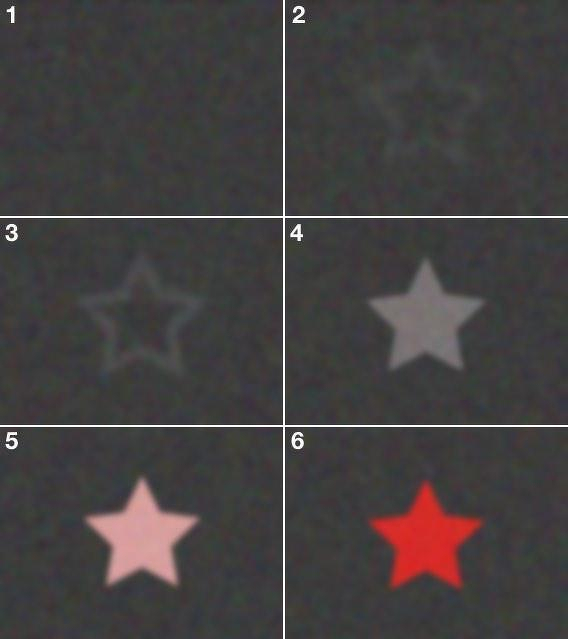

What’s interesting is that few people claim their imagined image is photorealistic. So we’re justified in asking:
-
Why shouldn’t we assume that, all things being equal, most or all people can “see” the difference between imaginary and real images?
-
So why wouldn’t those people use the distinctions to classify their own mental states?
-
Do we believe there are any people who have mental images so exact and photorealistic (in three dimensions) that they need some other way – such as introspection – to distinguish between their imagination and reality?
Granted, this is not definitive evidence, just another strand to be woven into a larger conclusion, making that conclusion more plausible.
Similarly, consider the claim “I am angry.” Is that self-perception a matter of intuitive recognition of an internal state? Or might it inevitably be an abstraction – an inference – from a proposition of the form “I am angry about <something external to the mind>.” That is, the mental state is downstream of some external event.
There is certainly much evidence supporting the inductive conclusion that all such emotions are externally triggered rather than self-generating. We should seek counterexamples. A problem is that not being able to think of a cause for anger doesn’t mean there wasn’t one. We can only hope that science will progress to the point where we can trace brain activity in some detail, allowing us to check for effects uncaused by anything external to the mind. Here, “external to the mind” might mean either strictly external to the entire body, or internal to the body but external to the mind. Consider, for example, the consequences of eating spoiled meat. They’re internal to the body (mainly the gut) but external to the mind.
VI. More research is needed
An argument can be made that when premises (propositions) appear in the mind, we often do not seem to immediately infer conclusions. When used as an argument that inference never happens, that’s weak.
Suppose someone is convinced of premises to the point of affirming them and acting on them but is not, apparently, convinced of the conclusion that logically follows. That only means the inference hasn’t been made yet.
That it can in fact be made is evidenced by putting that same person in a situation where the conclusion is relevant and (1) observing his actions to see if they accord with the conclusion and (2) then asking if he believes in the conclusion. These two kinds of observable behavior will usually be consistent with the idea that inference has been happening all along.
Sometimes such observations will reveal reasoning that appears faulty. But is that a sign that some other, non-inferential, process is at work? Not necessarily:
-
Inference is about the relationship between true premises and true conclusions. If the person started from one or more false premises, there’s no barrier to inferring a false conclusion.
-
Only deduction provides certainty. Induction and hypothesis provide only probable conclusions. If it happens the conclusion is false, that does not (necessarily) indict the inference procedure.
-
One of the premises may have been confused with another. We can treat such confusion as a claim that the person made a hypothesis that the differences between the two variants were irrelevant – which turned out to be wrong. Again, that does not indict the inference, just the person’s preparation.
-
But, finally, the rule of inference used may in fact be different than the three we allow. As a matter of logic, we can reduce this case to one of the three by considering the choice of inference method as an additional, implicit premise. Either that premise is wrong or it is being confused with a better one; in both cases, a valid rule is still being followed.
Another objection is harder. Doesn’t the claim that all propositions are derived from previous propositions lead to an infinite regress? Surely, there must be a first proposition that comes from somewhere else? Perhaps from an instantaneous, non-inferential conversion of sense input to a perceived subject?
Perhaps, but impossibility arguments based on notions of infinity often mislead. Think of Achilles racing a tortoise with a head start. The argument that Achilles can never win the race would be ironclad were it not for the plain fact that Achilles would win the race, and nobody seriously believes differently. Moreover, the calculus has, since Newton and Leibnitz, relied on similar absurdities of infinitely dividing finite quantities – and yet we surely don’t think calculus doesn’t work.
I am coming to the notion that continuity – the acceptance of the unlimited divisibility of time, space, and etc. – is a fundamental property of the universe (something I will someday call synechism). A key trick is to distinguish process (such as the process of inference) from results. I hope to do more someday than just gesture at a solution.
Liner notes for the 2026 reissue
The continuum
The idea of a continuum (defined below) as a central thing in the universe is perhaps not yet central to Peirce, but it will be. I don’t know that it’s settled into its final form in his mind, if it ever does, but at this point in my reading, some things stick out to me.
-
A key notion is that anything dividable into parts produces parts that are themselves divisible. The real numbers are a model or metaphor: there are an infinity of real numbers between any two real numbers. It’s early, though, for Peirce to be influenced by Dedekind and Cantor, whose work on mathematical continuity, the real numbers, and “naive” set theory are still in the (near) future as of these essays.
-
At this point, it’s significant that Peirce is thinking of resolving paradoxes with infinite processes that occur in finite times or over finite spaces. That idea will keep popping up: in this essay’s infinite chain of inferences, in next essay’s semiotics, in his evolutionary cosmology, and so on.
The instantaneous
Another of Peirce’s tics also pops up in this paper. He makes a distinction between instantaneous perceptions and perceptions that take place over time. Given indefinite subdividability, and his description of perception as a series of processing steps in which a whole “manifold” (or “bunch”) of inputs are “unified” (or resolved) into a single conceived-of object-in-the-world (a percept), I don’t get it. But he does keep returning to the distinction.
I speculate the explanation for the tic might lie in how Peirce differs from many other mathematicians of his time. He retained the old notion of infinitesimals as part of the justification of calculus after others had moved on to using limits to formalize calculus. Debate over infinitesimals got spicy. Peirce has a letter in the March 16, 1900, issue of Science that reads “Professor Royce remarks that my opinion that differentials may quite logically be considered as true infinitesimals, if we like, is shared by no mathematician ‘outside of Italy.’ As a logician, I am more comforted by corroboration in the clear mental atmosphere of Italy than I could be by any seconding from a tobacco-clouded and bemused land (if any such there be) where no philosophical eccentricity misses its champion, but where sane logic has not found favor.” Royce and Peirce were fans of each other! In 1885, in a review of one of Royce’s books, Peirce refers to him as “an American Plato,” and Royce arranged for Harvard to acquire Peirce’s papers (around 80,000 handwritten pages) after Peirce died.
Infinitesimals are a complicated topic, dating back to ~450BCE. As with so many terms in philosophy and science, the meaning morphs over time, often without an explicit acknowledgement that we’re now talking about something subtly but importantly different. One definition is that an infinitesimal is a non-zero number than is closer to zero than any non-zero real number. It’s a distinct kind of number in the same way that the square root of -1 is. Like that number, the infinitesimal comes with useful properties (such as that, in some interpretations, the square of an infinitesimal can be treated as being zero, making annoying terms drop out of equations).
Perhaps the appeal of the infinitesimal to Peirce is that it fits a distinction between an instantaneous perception and one extended in time (like running your finger over a swatch of cloth). They are different kinds of perception, just as an infinitesimal is a different kind of number, one that follows somewhat different rules – but still a number that can be used in combination with more normal numbers to solve practical problems.
Yeah, more research is needed on my part. For now: John L. Bell, “Continuity and Infinitesimals,” The Stanford Encyclopedia of Philosophy (Spring 2022 Edition), Edward N. Zalta (ed.)
“Peirce championed the retention of the infinitesimal concept in the foundations of the calculus, both because of what he saw as the efficiency of infinitesimal methods, and because he regarded infinitesimals as constituting the ‘glue’ causing points on a continuous line to lose their individual identity.”