“The Doctrine of Chances,” published March 1878, is the third installment of C.S. Peirce’s essay series “Illustrations of the Logic of Science.” It describes how to overlay probability on top of logic, and has early thoughts about continuity (in roughly the mathematical sense) and the social character of logic. It also gives hints of his later big theories of absolute chance (tychism), evolutionary cosmology, and the continuum (synechism).
Generally, I try to follow Peirce’s original structure when making these cover versions, but this one is rather a mess (possibly because it was originally one essay edited into two). So I’ve reorganized it.
Setting the scene
We live in a more settled time than Peirce. He lived at a time of intense intellectual change in biology (Darwin), geology (Lyell), mathematics (Cantor), logic (Boole and De Morgan), philosophy (although philosophy always seems to be in ferment), Randall Collins, The Sociology of Philosophies: A Global Theory of Intellectual Change (2009) has a take on why this is. experimental method and its teaching (von Liebig), political economy (the Gilded Age and unionization), not to mention technology. In Peirce’s publication year of 1878, the phonograph was patented, E. Remington and Sons produced the first typewriter with a shift key, the first telephone exchange was opened for commercial operation, the first sequences of stop-motion photography were exhibited, and the first truly industrial war (the US Civil War) was only thirteen years in the past. A lot of rethinking was required. These essays should be seen as part of that rethinking, rather part of its finished product.
TL;DR
Fields of science progress when they move from categorization and counting to measurement. What’s important about measurement is continuity: gradual change between measurements.
Logic is categorical. We can make it a better tool for inquiry by overlaying continuous probabilities onto the true/false categories. Given probabilities of premises, it’s straightforward to derive probabilities of observing different events. However, the more important problem is statistics: using current predictions to estimate underlying probabilities. Call this the problem of the probability of induction. It will be addressed in later essays.
Valid logical inferences have traditionally been truth-preserving: given true premises, they produce true conclusions. A common mistake when using probabilities is to treat the probability of a conclusion as independent of the probability of its premises.
A selfish person cannot be logical because logic requires that one identify with the interests of a community unbounded in space and time.
Continuity and the progress of science
The most basic form of science is categorization, such as a meteorologist classifying clouds into cumulus, nimbus, cirrus, etc.
A scientific field becomes more powerful when it adds counting. Consider botanical classification being aided by counting the number of stamens and pistils in a flower. Or counting the number of correct answers in a psychological test.
But the real power comes when the field begins to rely mostly on measurement, such as the number of clicks of a geiger counter divided by time (changing a count into a rate) or measuring the relationship between volume and pressure (Boyle’s law).
Francis Bacon said that there are two mental faculties: marking differences and noticing resemblances. Counting tends toward the first (as does classification), whereas measuring is more used to generalize and produce the nice scientific equations we like, such as
F=ma or E=mc². It does the latter by drawing our attention to small gradual changes.
 Continuity in action.
Examples of the use of calculus and differential equations in physics leap to mind, but continuity need not be numerical. Suppose you’re a naturalist who’s collected a set of animals that seem more or less alike. You notice that they all have a vaguely S-shaped marking. The shapes are not alike, but they seem to form a gradation such that you can imagine a new vaguely S-shaped marking between any two examples. Moreover, on a later expedition you find similar creatures that have a C-shaped marking instead of an S shape. Now the question is whether you can find a series of shapes that are intermediate between the S’s and the C’s.
Observing a gradual transition allows you to see the similarity behind apparent dissimilarity. You may come to consider a flower as a variation of a leaf, or the skull as a variation of the vertebrae.
Other times, one form can’t be reached from another via small steps. There’s a discontinuity, so you’re justified in putting the examples into different categories.
So useful is the idea of continuity that we frequently paste it onto situations where there’s no actual continuity. For example, it is not the case that there are 10.7 inhabitants per square mile in the United States, nor do 14.72 people live in the average New York house. We do such things because they work for our purposes. (Someday I will write about the utility of fiction in science.)
Probability
Logic, classically treated, is a categorization. How can measurement and continuity be added? Step one was taken by Boole, who modeled logic after algebra. Truth would be the number 1. Falsehood would be the number 0. Algebraic operators can then be used to calculate using arithmetic-like rules:
not 1 = 01 + 1 = 1,1 + 0 = 1, etc.1 × 1 = 1,1 × 0 = 0, etc.
Because those last two lines grate against our sense of arithmetic, let’s use different symbols: 1 ∨ 1 = 1 and 1 ∧ 0 = 0.
These are not the symbols of Peirce’s time, but you’re more likely to be familiar with them.
Boolean algebra has only two integers, but now you can overlay a segment of the real number line on them. So
0.0 is falsehood, and 1.0 is truth. The numbers between represent some sort of likelihood or propensity of a proposition being true. This suggests the mathematics of probability, which started with investigations of games of chance in the 1500s and 1600s. We’ve long known that if one die has a 1/6 chance of landing on •••, the chance of two dice both producing ••• is 1/6 × 1/6. Mind, that’s only provided the two dice are independent (that is, the throw of one die cannot affect the other).
 Whist, being played in 1906. Click to enlarge in a new tab.
Independence is a simple concept, but it can be tricky to determine. Consider the probability of getting three or four spades when dealt a hand in the card game whist. The probability of that should be approximately 0.51, assuming each card dealt is independent of its neighbor. However, in one experiment with 165 hands, 94 hands had two or three spades. The number predicted by combining probabilities would be 85. The difference could be due to natural variation (and the next essay will treat that topic), but it could also be because the cards are not truly independent.
Here’s a mechanism for whist non-independence: a deal in whist comes from a deck of shuffled cards. Those cards have been gathered up from the discards of the previous hand, with said discards being mostly groups of four cards of the same suit. So the input to the shuffle is non-random, and the shuffle is rarely good enough to eliminate that bias. As a result, what are called “short suits” are common enough that they’ve become part of whist jargon.
The meaning of probability
“Probability is the most important concept in modern science, especially as nobody has the slightest notion what it means.” — Bertrand Russell, some 1929 lecture.
There is dispute about what a probability actually means. This remains true in 2026. Fortunately, we have last essay’s pragmatic maxim, which asks us to consider what real and perceptible difference there is between a probability of, say, 0.5 and 0.6. Mr. Venn provides an answer in his recent (1866) book The Logic of Chance. If you have an urn of white and black balls and draw “enough” of them, replacing each after it’s drawn, the perceptible difference is what fraction of them are black. If the fraction tends to one half, the probability is 0.5. If it tends to 60%, the probability is 0.6. This is sometimes called the frequentist interpretation of probability or the materialist interpretation. An interesting consequence of this definition is that probabilities must be rational numbers (fractions), not irrational numbers like the square root of 2. But such irrational probabilities are required for quantum mechanics. Not a problem for Peirce, since quantum mechanics didn’t exist yet. Heck, radioactivity itself wouldn’t be discovered for another 18 years. We will adopt it.
The probability of an inference
Classical logical inferences are truth preserving. That means their operations are guaranteed to take true premises to true conclusions, as in this example:
- All men are mortal.
- Socrates is a man.
Then you know, with certainty, that:
- Socrates is mortal.
… because that’s the way this form of syllogism works: given its shape, we find ourselves compelled to accept the conclusion.
It’s also the way Boolean logic works:
A is trueB is false(or:It is true that B is false)
Therefore:
A ∧ B is false(or:It is true that...)
Now consider a different example, due to John Locke:
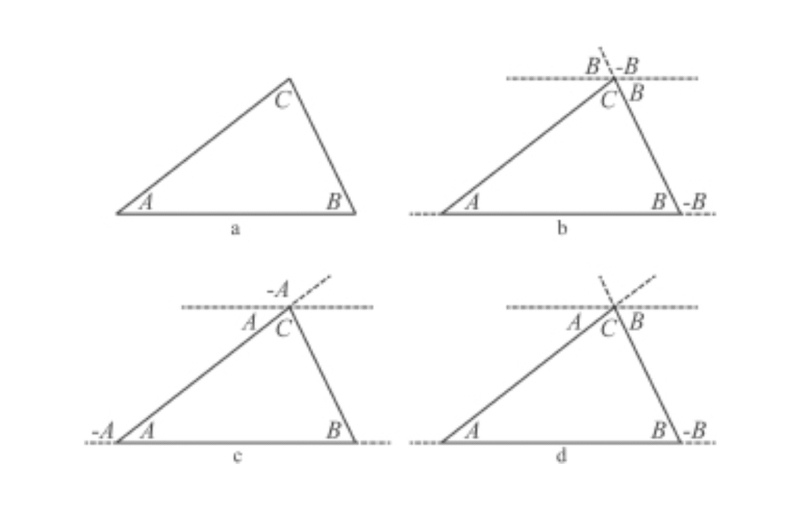 The proof.
Mathematician Alice reads, understands, and believes a proof that the sum of the three angles of a triangle is 180°. She has followed a truth-preserving deductive argument, thus she believes and can explain a true fact about triangles.
Later, Alice tells non-mathematician Bob of that conclusion. She doesn’t reiterate the proof: she just asserts a mathematical truth. Bob assents to it because Alice is not normally a liar, especially about mathematics.
This is a logical argument with a premise, a conclusion, and a reason (or operator):
- Premise: Alice understands that X is true.
- Conclusion: Bob believes X is true.
- Reason: Alice wouldn’t lie.
Let’s generalize:
- Premise: A mathematician professes that X is true.
- Conclusion: A layperson will believe X is true.
- Reason: Mathematicians are right about mathematics and don’t lie.
This premise only probably leads to the conclusion. As we’ve learned to our sorrow, a lot of people disbelieve something just because a “so-called expert” <insert spitting noise> asserts it. But we can obtain our best estimate for the probability of the “mode of inference” labelled “believe mathematicians” by calculating it in a frequentist way:
- Collect a number of mathematicians.
- Have each tell a mathematical truth to a layperson.
- Calculate the percentage of laypeople who believe it.
Two gambling problems
Classical logic seems less prone to gotchas than probabilistic logic. Here are two probabilistic puzzles.
Fatima gets one chance at heaven
Suppose Fateful Fatima has to draw a card from a deck. If the card is red, Fatima goes to heaven; otherwise, to hell. Fatima is allowed to choose from one of two decks. The first has 24 red cards and one black one. The second has one red card and 24 black ones. Of course Fatima will choose from the red deck, reasoning that gives her a 95% probability of going to heaven vs. a 5% probability when choosing from the black deck.
But does it? Not according to our definition of probability, which is based on the convergence of a large number of trials. Thus far, Fatima has made no trials, so there is no probability. Fatima’s choice makes sense under the logical interpretation of probability, in which you calculate probability based on a priori deduction, not on empirical evidence. It’s this logical interpretation than Peirce, following Venn, is rejecting. As noted in the first essay, a priori reasoning is less reliable than empiricism.
Suppose Fatima now draws from the red deck and gets a black card. (Bad luck!) Our best estimate of the chance of getting a black card from this deck is therefore:
(number of black cards drawn) / (number of cards drawn)1 / 11.0
And our best estimate of getting a red card from the red deck is currently 0 / 1 = 0.0.
Moreover, the probability of drawing a red card from the black deck is undefined, because:
(number of red cards drawn) / (number of cards drawn)0 / 0- “I am not programmed to answer that question.”
Both of these seem wrong. The wrongness is that we are thinking in terms of probability instead of statistics. Probability is future-oriented: given a knowledge of the probabilities of a situation, what will future samples likely look like? Statistics is backward-looking: given that a sample has been observed, what can we say about the underlying probabilities?
It is statistics that will let us cope with the way that estimated probabilities will bounce around as we feed new trials into the formula, but decreasingly so as the number of trials increases.
Still: it’s obvious Fatima should draw from the red deck. But why? What rule of inference is she using? (Hold that thought…)
The martingale
There’s a betting strategy called the martingale. If Betting Bob follows it, he will begin betting with some amount, say $1. If he loses his dollar, he’ll double his bet. Suppose he does and loses again. He must double his bet again, to $4. He loses again. He doubles to $8 and wins. He’s lost 1+2+4=7 dollars and won 8, so he’s $1 ahead.
It’s a flawless strategy except that at some point luck will run against Bob long enough that he doesn’t have enough money to double the bet. He will have to exit the game, most likely with less money than he started with.
The problem is that the probability of an inference procedure is defined by the convergence of an unlimited number of trials, whereas (1) in real life, you always have a finite number of trials, and (2) each such trial produces a distinct, concrete result – not a probability. In Bob’s case, the number of trials is bounded by his cash on hand, he got a specific sequence of wager results, and it is those results he has to deal with. Alice has it even worse, as she gets a single trial whose result will send her to heaven or hell. In the latter case, knowing that 95% of hypothetical other people will have made it to heaven would be no consolation.
Or would it?
Social science
There seems only one solution to this problem and it rests on a form of selflessness. Both Fatima and Bob have particular interests: Fatima is interested in not going to hell, and Bob is interested in making money. But to use logic properly, they must identify themselves with an unlimited community. Not just themselves, not just with us here today, but with every human who has ever lived and ever will live. And if the human species should die out, with the interests, activities, and fates of the species we can only hope will succeed us.
Logic is rooted in the social principle. Fatima picks the deck with 24 red cards because she is part of a tradition of working with probabilities that allows her to act as if she were doing an infinite number of trials. So her inference rule is not based on a particular deck of cards but on an intellectual history and what it would advise an unbounded number of people in her situation to do. That’s only logical.
It may seem odd to list the following as indispensable prerequisites for logic:
- identification with an indefinite community,
- recognition that such identification ought to trump self-interest, and
- hope for the indefinite continuation of intellectual inquiry.
But it makes sense. Recall from the first essay that a search for belief is motivated by doubt, and that logic is the only tool for escaping doubt that works in the long run. The other methods (the method of tenacity, the method of authority, and the logico-deductive method) fail because they conflict with human emotion. So why would it be odd for logic to succeed because of emotion?
We can tag the three prerequisites for logic with Charity (toward the larger community), Faith (that we can make an empathic leap), and Hope (that the community of inquiry may persist forever). Those, said Paul in 1 Corintheans 13, are the greatest of spiritual gifts. While Paul wrote no textbooks on logic, surely the New Testament is the highest authority on the dispositions of heart that a person ought to have.
Liner notes for the 2026 reissue
Like a lot of great thinkers, Peirce seized on certain key ideas and worried them to death. He himself thinks his success as a thinker is due in large part to his dogged, pedestrian persistence, which he called “Peirce-istance” or “Peirce-everance.” Haha! Cornelis, p. 20. Even this early, we see some of his obsessions.
The continuum: In this essay, Peirce presents continuity as just a matter of gradual change between densely packed points, but it will later loom much larger in his philosophy. As he engages with the mathematics of Cantor, he’ll come to describe such an extension of continuity as “the master-key which … unlocks the arcana of philosophy.”
Extensions of logic: it’s hard to tell from what I’ve translated so far, but Peirce is looking for a tripartite logic that underlies science (broadly defined): deductive logic (which gives certainty), his invention of abductive logic (which helps select among possible hypotheses that explain observations), and inductive logic (which expands abductive hypotheses in the direction of physical laws).
Community: Just as Peirce is less interested in individual giraffes than what people do with the concept of Giraffe, he’s less interested in the individual thinker than in the structure and evolution and logic of intellectual communities. For example, he’s an early writer on the mathematical economics of empirical research. See Kevin Bryan’s post on Peirce’s “Note on the Theory of the Economy of Research,” (1879). “Peirce is the father of a philosophical school for which selecting the best line of research to examine in order to learn inductively was a pressing concern. If you’ve ever read economics articles from the middle of the 19th century, this one will shock you: in style, I think it is essentially publishable today. It looks like 21st century economics. There are marginal tradeoffs. There is social science done by mathematical manipulation of heavily abstracted concepts. There is even a Marshallian diagram! It’s phenomenal.”
Chance: Peirce will come to see chance as a real causal power in the universe, not just a way we describe events sometimes going one way and sometimes another. This will eventually produce a cosmology that was arguably ahead of his time, and was just as arguably flat-out bonkers.
Evolutionary cosmology: The first essay had truth as a sort of limit case of unbounded inquiry. This essay has probability as a limit case of unbounded trials. Even the community of inquiry gradually changes over time in response to changes in its environment. In later essays, Peirce will argue that it’s not just our understanding of natural law that’s evolving; rather, what’s being measured is also evolving to become more precise and more lawlike.
Three: Anyone reading Peirce will be struck by how often his ideas come in triads:
| Charity | Faith | Hope |
| Induction | Abduction | Deduction |
| Feeling | Reaction | Mediation |
| Chance | Brute facts | Habits and laws |
| Possibility | Actuality | Necessity |
| Vagueness | Discreteness | Continuity |
| Some | This | All |
| Monadic syntax | Dyadic | Triadic |
| Sign | Object | Interpretant |
| Firstness | Secondness | Thirdness |
Philosophers have long wanted to discover the most abstract classifications of reality. Aristotle had ten categories. Kant had four top-level categories, each with three subcategories. Peirce had just three categories, which he called “firstness,” “secondness,” and “thirdness.” (Catchy!) He wanted to say that each of his triads reflected the three underlying fundamental categories, but he also allowed that he might just be fond of tripartite divisions. Beats binary good/bad divisions, I say.