This is a rewriting of C.S. Peirce’s earlyish essay “How to Make our Ideas Clear,” published January 1878 in Popular Science Monthly. It’s the second of a series of six essays, collectively titled “Illustrations of the Logic of Science.”
It introduces the semi-famous “pragmatic maxim” and the idea that truth is the limit (in something like the mathematical sense) of scientific-ish inquiry.
Although it’s perhaps Peirce’s most famous text, it’s kind of a mess. I’ve stripped out a lot of what I judge to be digressions. Once an editor, always an editor.
My cover band metaphor for this series.
TL;DR
People believe all sorts of crazy things. The previous essay talked about different ways of instilling and solidifying beliefs. It ended up gesturing toward science as having the best approach. But now we have to dissect what that approach is. This essay takes the first step by advocating looking at the practical difference between what we’d do if we believed something vs. if we didn’t believe that something.
This is perhaps most valuable for avoiding pointless conversations. If Brian says he believes X and Dawn says she believes Y, but they always act the same in situations where their beliefs apply, can’t we just say Brian and Dawn believe the same thing?
Also, an important idea is introduced: that true belief is not an individual project, but only justified by many people investigating the issue for who knows how long. Truth is a kind of convergence to a fixed point.
I
Skipped. It’s about a post-Descartes trend in philosophy: (1) use “clear” and “distinct” in technical senses (that Peirce correctly points out are far from clear). Then (2) if your idea is clear and distinct, it is consequently true. You can find truths about reality without any input from reality. Peirce says that’s a defunct pre-scientific idea.
II
 hummer!
Dawn is back on the east coast, taking care of her ailing mother. She misses her life back here in the midwest, which provoked a thought in me: how I can help her mood? One day, she asked me if the hummingbirds were still coming to Illinois, as they’d mostly vanished from New Hampshire near the seacoast. So I formed a belief: she’ll be pleased if I send her a picture or video of a hummingbird every day.
That’s not hard. In the mornings, I sit in “my nest,” a comfy chair next to our big bay window. A slight turn of my head shows this scene:

There are three sources of hummingbird nectar in that view: one hummingbird feeder and two plants that nectar-feeders l-o-o-o-v-e. When sitting, I can see them all in my peripheral vision. Peripheral vision isn’t good for clarity, but it’s excellent at detecting movement.
Oh look! There’s something now (I perceive motion). I turn my head (the habitual action that results from my belief that a glimpse of movement means there might be something image-worthy outside).
It’s actually a big old bumblebee. Indecision: should I take a picture? Dawn likes bumblebees too. How about a video, because this bee is bobbing up and down entertainingly? I form a belief: Dawn would like this.
That belief causes an action: checking if the phone is set for video, expanding the zoom to 9X, then taking the video. The goal of that compound action is to produce in me a future perception (of a visual image).
My perception of the resulting video raises doubt: is this worth sending to Dawn? The doubt is resolved into a belief that it is. That particularized belief sends me to the in-phone video editor (because I believe Dawn will prefer not to see the bobble at the end while I’m stopping the recording).
When I believe I can’t improve on the clip (at least without learning new skills), that triggers the two-click habit of texting the video to Dawn.
I used “perception” in the above. It might be better to use percept, which you can think of as a summary description that names an event in the world like “the ringing of a phone.“ In this early stage, Peirce doesn’t use “percept,” but he starts around 1900. I haven’t yet worked through how his use of the word squares with its modern use.
Here’s a summary of the process:
-
Getting along in the world means moving from percept to percept, with beliefs and actions as intermediate steps.
Habits are triggered when some percept matches the previously laid-down prerequisites for bringing some belief to mind.
The habit is not in itself a detailed plan of action. Instead it triggers more mental activity to produce what you might think of as a step-by-step plan… if you’re inclined toward conventional cognitive science, or a learned reflex if you’re inclined to embodied/ecological cognition.
That action is predicted to produce a downstream percept that will pattern-match some intended success criteria.
perception➤
percept➤
belief activation➤
action & a predicted later percept -
Percepts can also result in doubt, which is only resolved by reasoning that modifies an existing belief or creates a new one. This new belief is to be activated immediately or when the originating percept happens again.
doubt➤
irritation➤
thought➤
belief+habit -
Implicit in the above is that taking action on the belief that I should take a video for Dawn will require the activation of other beliefs, such as one about the relative merits of slow-motion or normal speed video for movement of a bumblebee’s sort.
But it is not “beliefs all the way down.” The process always “cashes out” in real or potential action. (Potential because, for example, my action of capturing a picture of a hummingbird is frequently foiled when the bird in question zips off before I’ve gotten the camera ready.)

Ideas about things
In the previous example, I was working with beliefs activated by events. What about beliefs activated by thinking about things out there in the world? The same process applies.
Here’s an example. Many Christian churches practice a sacrament where bread and wine are given to the congregation as a remembrance of the Last Supper. Some churches believe that’s all there is to it. Others believe that the wafer and wine are literally transformed into the body and blood of Christ.
Are those really two different beliefs? If our only conception of an object is the actions it can provoke, and the sensations they provoke, what sensations will blessed wine produce that are different from ordinary wine? There are none. Consequently, calling the wine blood is just jargon.
Thinking in this way leads to what will, in the near future, be referred to as the pragmatic maxim:
Consider what effects, which might conceivably have practical bearings, we conceive the object of our conception to have. Then, our conception of these effects is the whole of our conception of the object.
III
In the preface of his text on analytic mechanics (Vorlesungen über mathematische Physik: Mechanik, 1876), Gustav Kirchhoff writes that we understand precisely the effects of force, but we do not understand what force is.
By the pragmatic maxim, his distinction is meaningless. Having a precise understanding of the effects of force is an understanding of what force is. It is “the whole of our conception of it.” Consider:
One traditional definition of physics is the science of matter in motion. Tim Maudlin, Philosophy of Physics: Quantum Theory, 2018. Left alone, matter in motion continues at a constant velocity – in a straight line, at the current speed, forever. (This includes the limit case of not moving at all).
Changes in velocity (speeding up, slowing down, or heading off in a new direction) always occur gradually, over time. We call that change over time acceleration. Force is just the mass of the matter-in-motion × the acceleration. The “habit” of applying F=ma to moving objects is part of our conception of force.
Whether we say that a force causes acceleration or that it’s a number obtained by dividing acceleration by mass is entirely a matter of convention, no different than saying “It is cold” to an Englishman and “Il fait froid” to a Frenchman. It changes nothing about the facts of the matter or what force means.
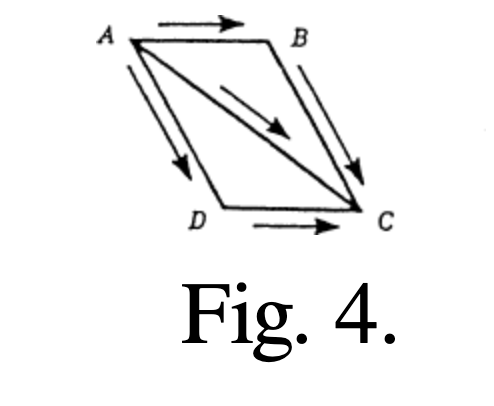
F=ma is not the only part of force’s meaning. The parallelogram of forces can be used to convert multiple forces into a single one, as shown to the side. The use of that parallelogram to predict future movement is part of the physicist’s conception of force.
I was surprised to learn that, nowadays, the parallelogram of forces is considered an empirical finding rather than one that can be proved from first principles.
F=ma and the parallelogram are the entirety of our conception of force because they capture what we do with our conception of force that has observable effects.
IV
Let’s go further up layers of abstraction and ask what is our conception of reality (or the Real, as philosophers often put it)? Alternately, what’s the difference between a real thing and an unreal thing such as a fiction, figment of the imagination, or dream?
As a case study, consider a dream I had as a child in which everyone but me turned into a bobbing clown head on a spring – a sort of Jack-in-the-box.
That may have been inspired by the “It’s a Good Life” episode of the Twilight Zone or perhaps the Jack-in-the-Box in “How the Grinch Stole Christmas,” a story I love except for its tragic ending.What of that experience was real?


- It is real that I had a dream.
- It is real that I had a dream about a Jack-in-the-box.
- The Jack-in-the-box was not real. It was something that my mind made up. Even if I believed it were real, it wouldn’t be.
This suggests that the Real is that which is independent of what anybody believes about it. Or, as Philip K. Dick will put it, “Reality is that which, when you stop believing in it, doesn’t go away.”
But reality isn’t the only cause of our beliefs. Consider the previous essay’s “nice guys finish last.” Do people believe that because they’ve thought about the evidence? Or because a parent taught them?
Science gives us a clue about how to proceed. Consider a bit of reality many of us believe: the speed of light is 299,792,458 meters per second, plus or minus some error bounds. How do we know that?
- One person estimated it by studying the transits of Venus across the sun.
- Another used the eclipses of Jupiter’s satellites.
- Another used a toothed wheel apparatus.
- Another used a rotating mirror.
- etc.
Over time, these different estimates converged on the value we use today. This is a characteristic of scientific research: whatever your starting belief, the process of investigation carries you, by a force outside yourself, to a consensus conclusion.
Reality is the inevitable end of inquiry. The truth is an opinion that all who put in the effort must eventually adopt. Whatever such consensus “points to” (like that light is a thing that has a speed roughly the one given above) is real.
Yes, some perverse people might continue disputing such beliefs forever, possibly past the end of our species. However, if another species arises after ours, they will – if they carry inquiry far enough – eventually come to believe the same truth.
This implies that belief can be a gradual process, one that comes in gradations. Which brings up the mathematical/philosophical topic of probability (more novel in 1878 than today). Next essay.
Liner notes for the 2026 reissue
I have comments about Peirce’s theory as presented here. However, I’ve been working all day trying to express them, and the Writer’s Block is strong in me. I’ll just list them and move on.
-
Peirce is compatible with modern ideas of the brain like ecological psychology, which emphasizes that the brain’s job is to maintain a tight loop from perception to action to perception. And theorists of the “predictive brain” agree that it spends effort predicting how the results of an action will later be perceived by this same brain.
-
However, there are important differences: the above theorists seem to emphasize that concepts/beliefs are summaries of experience, not cogitation about isolated entities like “wine.” Further, Peirce conceives of perception as an instantaneous snapshot, whereas my understanding of the modern view is that perceptions are of events that take place over time. (So predictions of perception are little state machines that accumulate sensations to make a final judgement on whether their predicted event has happened.) In my current opinion, Peirce’s distinction between immediate perception and extended thinking will lead him down unproductive paths.
-
The pragmatic maxim is “Consider what effects, which might conceivably have practical bearings…” That’s not very clear. I can conceive of perceptions (like hearing what people say about a church service) that are distinct effects of differing beliefs about transubstantiation. Do those have “practical bearing?” Why not? I think William James, the popularizer and modifier of Peirce’s pragmatism, would think there were practical differences between the effects of different beliefs about transubstantiation. Some read James’s Pragmatism as intending to justify religious faith because of its good practical effects.
-
I was the one that made up the example of “nice guys finish last.” Peirce’s examples in the essay are all about nouns: Wine, Hardness, Weight, Force, and the Real. That, I believe, is because the definitions of abstract entities had always been a big deal in philosophy, and it dragged him down. He’d be better off talking about truth-valued claims, but the logic of his time was still all about definitions of classes of objects. (It changed during Peirce’s lifetime. Peirce both tracked the changes and contributed to them.)
Peirce was thinking in a context that made some topics the topics anyone like him would have to address. I think he only partly broke out of his epistemic bubble, and it distorted his presentation and thought. It’s hard to be a thoroughgoing iconoclast.