The title plays on “Last Song About Satan” by Slim Cessna’s Auto Club, a country-rock band credited as a founder of the “gothic country” genre (“a genre of country music rooted in early jazz, gospel, Americana, gothic rock, and post-punk.")
I don’t think of Popper or the critical rationalists as satanic, but I do resonate with the theme of the song as captured here:
Well, I must’ve gone back in time
About the time after Jesus died
He was down there preaching in that hole
To all us dark and lonely souls
And He said “Son, why are you here?
You should be back home drinking beer
Writing songs about God and glory
Don’t use the Devil in your story”[Chorus]
Well, this is my last song about Satan
No more songs about evil or filth or bile and booze
No more songs about my hell, I’ve nothing left to prove
I could say more about reasons why critical rationalism is a bad methodology of science – you should see my notes – but any remaining readers (hi!) are either convinced or not.
So I’ll finish with three narratives of discovery: C.S. Peirce’s account of Kepler’s discovery of his three laws of planetary motion, Imre Lakatos’s account of Newton’s theory of gravitation, and Andrew Pickering’s story of Hamilton’s discovery of quaternions. I’ll (mostly) just let the richness and… plausibility of the first and third accounts contrast with the narrowness of the second, and (mostly) just let you sit with the question of which of the three narrators seems more likely to have insight into my original question: why does science work so well?
Kepler
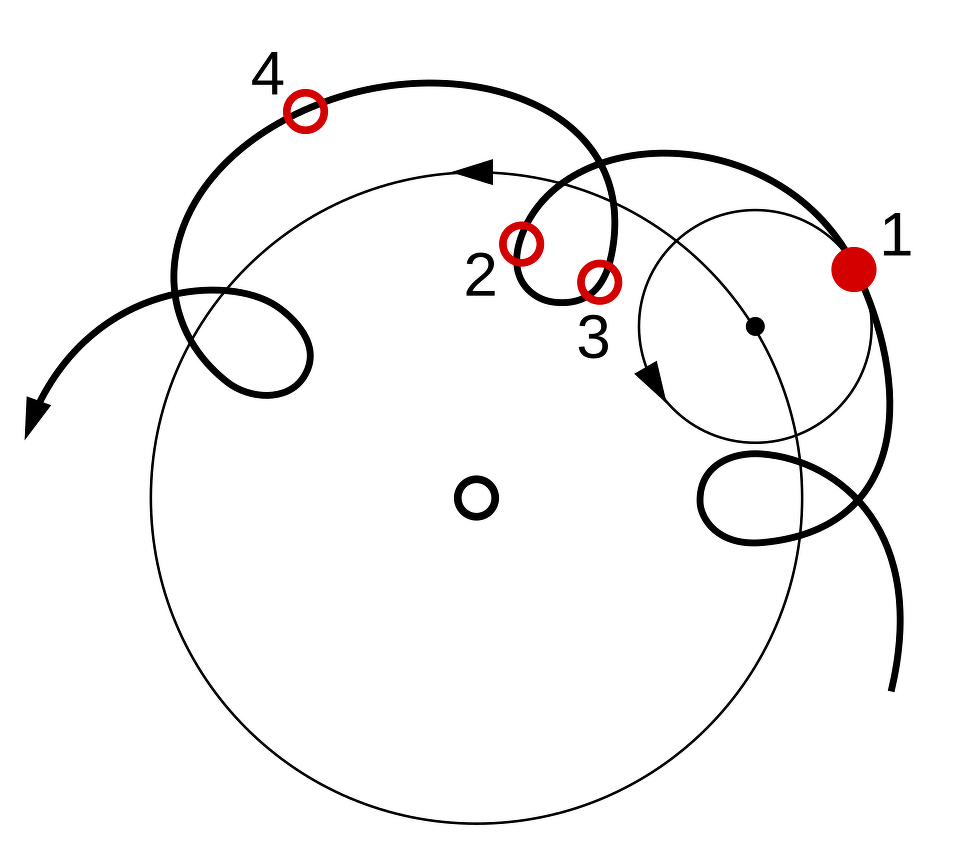
This is the story of how Johannes Kepler came up with his three laws of planetary motion: (1) planets move in elliptical orbits, (2) their speeds vary such that every day a planet sweeps out an equal area of the ellipse (not an equal distance along the orbit), and (3) the ratio of two planets' years (their orbital periods) is proportional to the ratio of their orbits' major axes raised to the 1.5 power.
The story I’m retelling comes from Charles Sanders Peirce (1839-1914), an American scientist, philosopher, and all-around polymath. Quotes are from Philosophical Writings of Peirce, Justus Buchler (ed.), 2001. (archive.org), particularly the chapters “Abduction and Induction” and “The Fixation of Belief.” If you want to check my summary, you can find the relevant parts of those two chapters at a “Peirce on Kepler” page.
The problem Kepler had was this:
 The epicycle is the little circle (upper right) riding along the larger circle.
 The equant is the dot above the X that marks the center of the big circle. The planet orbits around the equant, not the center.
-
The Ptolemaic (earth-centered) theory “agrees with the appearances [observations], although there were various difficulties in making it fit exactly.” Those difficulties required kludges: epicycles and equants.
-
The Copernican theory originally inherited the kludges of Ptolemy. For example, it did not actually put the sun at the center of the universe with everything orbiting around it. Instead, the sun orbited around an equant, as did all planets. (That is, they all orbited around the same point, rather than there being a different equant for each planet’s orbit. I think.)
-
At that point, Copernican theory could be seen as merely a mathematical transformation of Ptolemaic theory, unable to produce different predictions. Kepler wanted better evidence for the heliocentric universe than that.
-
Measurements of the apparent motion of the planets were iffy, though Kepler had some access to Tycho Brahe’s best-in-class measurements.
How did Kepler proceed?
-
He knew (as Ptolemy did not) that the Sun is much bigger than the Earth: at least 15 times bigger. The sun’s diameter is actually 109 times that of the earth. Measurement has improved since Kepler’s time. So it seemed sensible for the Sun to somehow be the cause of the orbits of the other planets.
-
Even though all orbits were supposed to be circular, epicycles meant that each Copernican planet has a point where it’s furthest from the center and a point where it’s nearest. A line drawn between the two is called the “apsis.” Kepler looked at the apsides (plural of “apsis”) for the Earth and Mars.
“[He] utilized various observations most ingeniously to infer that they probably intersected in the sun” (not at the center of the sun’s supposed orbit around the equant).
-
From this, Kepler thought it reasonable to put the sun, immobile, at the center. That had consequences for when he made observations in support of calculating an orbit:
“Thence it followed that the proper times at which to take the observations of Mars for determining its orbit were when it appeared just opposite the sun-the true sun-instead of when it was opposite the mean sun, as had been the practice.”
-
“Carrying out this idea, [Kepler] obtained a theory of Mars which satisfied the longitudes at all the oppositions observed by Tycho and himself, thirteen in number, to perfection.”
-
“But unfortunately; it did not satisfy the latitudes at all and was totally irreconcilable with observations of Mars when far from opposition.”
However, Kepler’s progress thus far allowed him to make a leap from the earlier notion that planets move at the same speed at all times. He replaced that with the idea that they sweep out a constant area, meaning the orbital speed varies.
At this point, Kepler was still assuming circular orbits, so I don’t know how distance vs. area makes an observable difference when the sun is at the center. Perhaps this is another shift (like from Ptolemaic to the original Copernican cosmology) that produces no new predictions but readies you to look in a new direction. A quote from Richard Feynmann comes to mind: Richard Feynman, The Character of Physical Law, 1967, p. 53, emphasis mine.
“Mathematically each of the three different formulations [of the law of gravitation], Newton’s law, the local field theory and the minimum principle, gives exactly the same consequences. What do we do then? You will read in all the books that we cannot decide scientifically on one or the other. That is true. They are equivalent scientifically. It is impossible to make a decision, because there is no experimental way to distinguish between them if all the consequences are the same. But psychologically they are very different in two ways. First, philosophically you like them or do not like them; and training is the only way to beat that disease. Second, psychologically they are very different because they are completely unequivalent when you are trying to guess new laws.”
If so, I speculate that Kepler’s shift in theoretical presupposition prepared him to deal with observations differently.
-
“Subsequently, finding that the planet moves faster at ninety degrees from its apsides than it ought to do, the question is whether this is owing to an error in the law of areas or to a compression of the orbit. [Kepler] ingeniously proves that the latter is the case.”
That is, observations forced Kepler to abandon the assumption that orbits are perfect circles.
-
But if not circles, what? An egg shape? Or what?
“He accomplished [finding that planets move in ellipses] by his incomparable energy and courage, blundering along in the most inconceivable way (to us), from one irrational hypothesis to another, until, after trying twenty-two of these, he fell, by the mere exhaustion of his invention, upon the orbit which a mind well furnished with the weapons of modern logic would have tried almost at the outset.”
Peirce described this as “the greatest piece of Retroductive reasoning “Retroduction” is a synonym for abduction, which Peirce treated as a logic of discovery. Its modern usage tends to focus on justifying a conclusion (“reasoning to the best available conclusion”), but Peirce uses as a way to select hypotheses. ever performed.”
My reaction
This story has a rapid feedback between observation and theorizing that you don’t find in critical rationalism. Kepler’s laws didn’t just appear: he grew them via a process of iteration.
My summary doesn’t properly convey the concern with measurement and measurement error. Peirce was a working scientist, largely for the United States Coast and Geodetic Survey, where he got extensive experience with the practical details of measurement of things like local gravity (via pendulums, some of his own design), the orbits of double stars, the brightness of stars, and the shape of the Milky Way. He also did early work in experimental statistics of the p<0.05 sort.
The critical rationalists don’t care about this stuff at all. They have nothing useful to say about statistics, just that working with statistical hypotheses involves “risky decisions.”
Newton
Imre Lakatos paints Newton as a very different sort of scientist than Kepler. My source is “The Methodology of Scientific Research Programmes,” in Criticism and the Growth of Knowledge, Lakatos & Musgrave (eds.) (1970) (full text), pp. 135-6. You can find that text at “Lakatos on Newton” if you want an easy way to check my interpretation.
-
In Lakatos’s narrative, Newton used Kepler’s sun-centered elliptical orbits to investigate what you could deduce if you assumed a centripetal force (gravity) pulled on the planets. (Kepler, in keeping with the metaphysics of his time, assumed that “fibrils” of some unknown composition stretched from the sun to the planets and effectively pushed them around.) A simple one-planet model allowed Newton to demonstrate that such a force would vary with the inverse square of the distance to the planet.
-
Newton apparently already had his three laws of motion, and his model violated the third. “To every action [force], there is always opposed an equal reaction; or, the mutual actions of two bodies upon each other are always equal, and directed to contrary parts.” Therefore, he complicated his model to have the sun and planet orbit around a common point (much closer to the sun because of its much greater mass).
-
He kept adding complexity to the model, such as replacing infinitely-dense point masses with spherical masses extended in space, which required him to invent new math (calculus, I suppose). Then he added spinning (and tilted) planets. And so on.
-
It was only near the end of his work, when his model had progressed to one incorporating interplanetary forces, that “he started to look more anxiously at the facts. Many of them were beautifully explained (qualitatively) by this model, many were not.” Lakatos doesn’t say, but I wonder whether the anxiety was because Newton was now trying to solve the Three Body Problem, which isn’t tractable with the mathematical tools he had. That would explain, perhaps, Lakatos’s parenthetical in “beautifully explained (qualitatively).”
When evaluating this story, we have to ask…
Is Lakatos credible?
Given that, as I’ve demonstrated (here, here, and here), Lakatos (and Popper) are sloppy about the historical record when it allows them to criticize people they despise, it’s fair to ask if Lakatos isn’t doing the same, in the opposite direction, for a person he idolizes?
That’s more plausible because of Lakatos’s use of “rational reconstruction” in his philosophy of science. It allows him to present history as it should have (rationally) gone in order to contrast that to how history actually went. In practice, he leaves off the “how it actually went” a disturbing amount of the time. See Kuhn’s comments in “Response to my critics.“ Criticism and the Growth of Knowledge, p. 255, footnote 1.
“But a historian would not include in his narrative a factual report which he knew to be false.” (Kuhn’s italics, complaining that Lakatos admitted to doing just that in his earlier contribution.)
… and, responding to a case where Lakatos deemed Balmer’s observations of atomic spectra irrelevant to the development of theory: ibid., p. 246.
“Lakatos’s attempt to reduce science to mathematics, leaving no significant role to experiment, goes vastly too far. He could not, for example, be more mistaken about the irrelevance of the Balmer formula to the development of Bohr’s atom model.”
That is in response to Lakatos’s claim ibid., “The Methodology of Scientific Research Programmes,” p. 147. that:
“[T]he progress of science would hardly have been delayed had we lacked the laudible trials and errors of the ingenious Swiss school-teacher [Balmer]: the speculative mainline of science, carried forward by the bold speculations of Planck, Rutherford, Einstein and Bohr would have produced Balmer’s results deductively, as test-statements of their theories, without Balmer’s so-called ‘pioneering’. In the rational reconstruction of science there is little reward for the pains of the discoverers of ‘naive conjectures’. (My emphasis.)
Is the lack of reward because those pains didn’t matter as a matter of historical fact, or that Lakatos would prefer they hadn’t mattered? Kuhn suggests the latter, and I believe him.
My reaction
Kuhn is right about “attempt[ing] to reduce science to mathematics.” Consider Lakatos’s (brilliant) book, Proofs and Refutations: The Logic of Mathematical Discovery, which looks at how mathematician’s definitions and proofs evolve over time in response to counterexamples. From the title, you can see that it’s working in the vein of Popper’s Conjectures and Refutations and his The Logic of Scientific Discovery. Lakatos’s later methodology of scientific research programmes is a minimal extension to adapt his ideas to the realm of physical science. By paying so little attention to how mathematics and science are different, he’s missing a lot that might just matter for the success of science.
Note also that Lakatos shows Newton in another iterative loop but, unlike Kepler, it’s not a loop between theory and experiment. I’d characterize it as a loop between theory and thought experiment where the thought experiments are used to develop not so much the theory as some problem-solving approaches.
If I’m interpreting the story correctly, what Newton does is closest to the prediction step of the critical rationalist’s theory⇒prediction⇒test sequence. He derives his law of gravitation by asking how gravitational force would have to work for it to cause elliptical orbits. Kepler tried to do the equivalent, based on planetary inertia and the elasticity of the fibrils connecting the sun to the planets. His attempt didn’t work out as well as Newton’s did. This seems to me the same sort of derivation as using Newton’s four laws to derive the equation of motion of a pendulum: a kind of applied science. All the theoretical thinking happened before the story began.
Newton’s later work didn’t add more theory, as far as I can tell. Instead, he challenged himself with more complex thought experiments, and so developed the math to predict the movements of the imagined entities. Cue centuries of physicists solving differential equations.
In Lakatos’s telling, Newton never has to backtrack after being wrong. There’s a forthcoming book, The Winding Trail to Newton’s Principia Mathematica which I bet complicates the story. I’ve preordered it and will be checking the Lakatos account. I’ve also bought John Banville’s Kepler, which covers the time during which Kepler discovered his laws. Looks good so far. I have a feeling the scientific issues will be presented realistically.
Hamilton and quaternions
My text here is Andrew Pickering’s 1995 The Mangle of Practice: Time, Agency, and Science. 22 years ago, I summarized his chapter on how William Rowan Hamilton came to invent (or discover) the mathematical abstraction of quaternions. Here’s an even shorter version.
Hamilton was trying to find connections between three-dimensional geometry and algebra (akin to existing results in two dimensions).
He started with a supposition: if point (x,y) corresponds to the formula x+iy, perhaps (x,y,z) corresponds to x+iy+jz. Here, both i and j are imaginary numbers such that ii=-1 and jj=-1.
After that (minor) creative leap, Hamilton began asking questions about how 2D operations like adding or multiplying points would work in 3D. A simple first question was “what is the square of a 3D point?” When it comes to the algebraic representation of a 3D point, there’s no creativity involved: just calculate(x+iy+jz)². It’s this:
x² - y² - z² + 2ixy + 2jxz + 2ijyz         (1)
                             ^^^^^
This act of calculation is what Pickering calls disciplinary agency. Hamilton stopped being creative and just let the rules of algebra take charge.
Hamilton then shifted to geometry. He used geometrical rules to compute (x,y,z)², then translated the result into algebraic notation, yielding:
x² - y² - z² + 2ixy + 2jxz (2)
Formula 2 describes the same point as does formula 1. Notably, 2 is missing the 2ijyz term, which means it must be equal to zero.
Now Hamilton flipped back into a creative role. Note that the term includes multiplying two different imaginary numbers, i and j. What does that mean? An appealing answer is to say ij=0, which makes the 2ijyz term drop out, as required.
However, when he moved from multiplying a point by itself to multiplying one point with another, that didn’t work out. (The algebraic and geometrical “disciplines” didn’t produce the same answer.)
The next creative leap was bolder. Everyone knows about commutativity. Of course 5×3=3×5. However, Hamilton asked “What if commutativity doesn’t apply here? What if ij=-ji?” If you work through the algebra, that would also cause the 2ijyz term to drop out.
For reasons I don’t remember, that suggested to him that perhaps ij equalled a new imaginary number, k. He worked out all the combinations of multiplications of i, j, k, and found he’d discovered how to make all algebraic manipulations give the same answer as the corresponding geometrical manipulations.
Except that, since he was working with three imaginary coordinates (
i, j, and k, plus the original unadorned x), he’d moved from three dimensions to four. He’d been working on a problem in 3D geometry and had ended up creating a tool that worked with 4D geometry.
This discovery of having actually achieved a different goal than you intended is a theme of Pickering’s. Another chapter recounts how the physicist Donald Glaser wanted to do old-fashioned “bench top” solitary science, so he invented tiny bubble chambers to study cosmic rays. They didn’t work so well for that, but they did work way better than cloud chambers when they were drastically scaled up and connected to big particle accelerators. Bubble chambers, in fact, became the exemplar of the very sort of Big Science Glaser had been fleeing. So, after he collected his Nobel Prize, he switched to biology and did bench-top work.
 A dainty little bubble chamber
My reaction
Pickering’s story is a story of backtracking, iteration, and feedback.
In contrast, Lakatos’s account of Newton is an example of what I call the planning myth. If you’re sufficiently smart and work sufficiently hard, you can devise a plan (represented as a series of intermediate goals) that can be achieved by knocking off each goal in turn. If you have to backtrack a little – “let’s reevaluate the current goal” – that’s probably because you didn’t think hard enough or weren’t smart enough. If you have to backtrack a lot, that’s probably because you’re not smart enough and you should find a different job.
Peirce and, especially, Pickering think that backtracking is just the way things are. It is an inherent part of creative work. Attempts to front-load it – to shove all the creativity and “Aha!” moments to the front end of the process, leaving the discovery of gotchas to those (experimenters, testers) thought to have fewer skills and, frankly, lesser worth – are bound to fail.
Let’s get this over with
Popper had one really good idea: be obnoxious about asking “How would you know if you’re wrong?” And he had a sociological observation that’s also good to keep in mind: people presented with a counterexample or anomaly will often try to explain it away rather than change their mind. (When push comes to shove, what they said would convince them they were wrong… doesn’t.)
Those two claims are decent parts of a methodology of science. Very limited, though – not deserving of all the superstructure and hair-splitting and abstraction the critical rationalists built on top of them.
For real understanding of why science works well, we must look elsewhere, to people more willing to have The Rules address the full range of what scientists actually do.