I made a mistake in the previous post. However, in true pundit style, I claim the correction just reinforces what I’ve been saying all along. (What’re the odds?!)
Correcting the mistake reveals a methodologist who looks at unfinished work and makes a judgment due to bias, bias unchallenged by his own methodology. That happens a lot with methodologists. At least, so it seems to me.

The correction
I wrote “People don’t mention it, but Newton’s masterwork – his law of gravitation – is instrumentalist [non-causal].”
While cleaning up the notes I took on the Criticism and the Growth of Knowledge proceedings, I noticed a quote was missing a page number. Searching for that passage in the text, I rediscovered the following text nearby. Lakatos, “The Methodology of Scientific Research Programmes,” p. 145, in Criticism and the Growth of Knowledge, Lakatos & Musgrave (eds.) (1970) (full text)
Lakatos is speaking. Italics in the original. I’ll interpret the quote below.
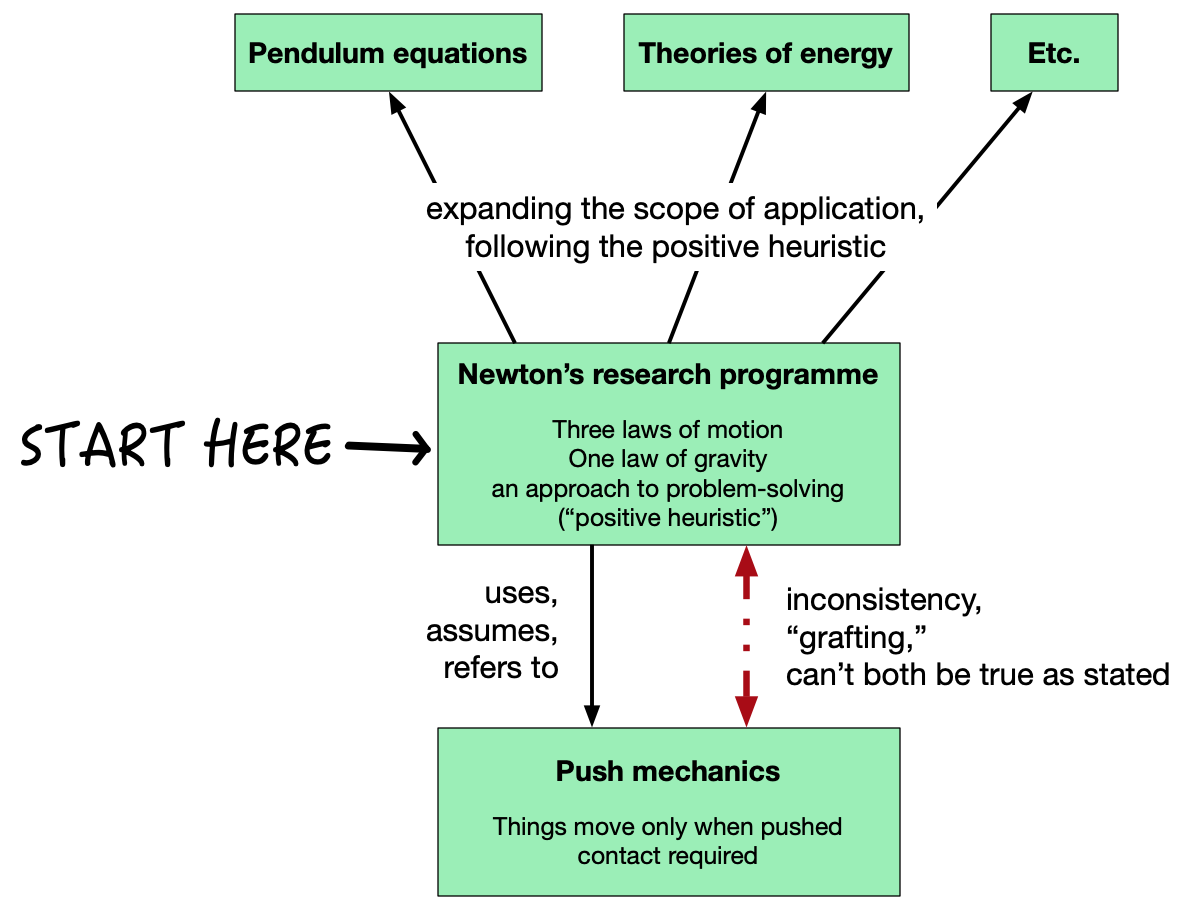
“The rational position is best characterized by Newton’s, who faced a situation which was to a certain extent similar to the one discussed. Cartesian push-mechanics, on which Newton’s programme was originally grafted, was (weakly) inconsistent with Newton’s theory of gravitation. Newton worked both on his positive heuristic (successfully) and on a reductionist programme (unsuccessfully), and disapproved both of Cartesians who, like Huyghens, thought that it was not worth wasting time on an ‘unintelligible’ programme and of some of his rash disciples who, like Cotes, thought that the inconsistency presented no problem.”
 Click to enlarge in a new tab.
-
“Cartesian push-mechanics” refers (I think) to Descartes' 1644 proposal that seemingly empty space is filled with “subtle matter” moving in circular vortices. Because of centrifugal force, matter moves to the outer edges of the vortex, where it condenses. This condensed outer matter pushes “rough matter” (which has more inertia) toward the center of the vortex, and that pushing is exactly gravity. See Sophie Roux, “The Reception of the Galilean Science of Motion in Europe,” in Cartesian Science, Kluwer Academic Publishers, pp. 25-66, 2004, for more details than I absorbed. (I skimmed.) This differs from Aristotelian mechanics, where an object isn’t pushed but moves, when permitted, toward its “final cause": very roughly, that place where it is in the object’s nature to be. (Matter “wants” to be at the center of the earth; fire “wants” to be in the heavens.)
-
What Lakatos means by “grafted” is not entirely clear to me. The important bit is that the grafted theory is logically inconsistent with a theory that it makes use of. They can’t both be true.
-
A scientist can do two things:
- Fix the inconsistency, perhaps by replacing the older theory with a newer one, perhaps by adjusting the new theory.
- Ignore the inconsistency and continue working on the “positive heuristic.” That would be things like applying Newton’s laws to a new set of problems (like the motion of various sorts of pendulums).
-
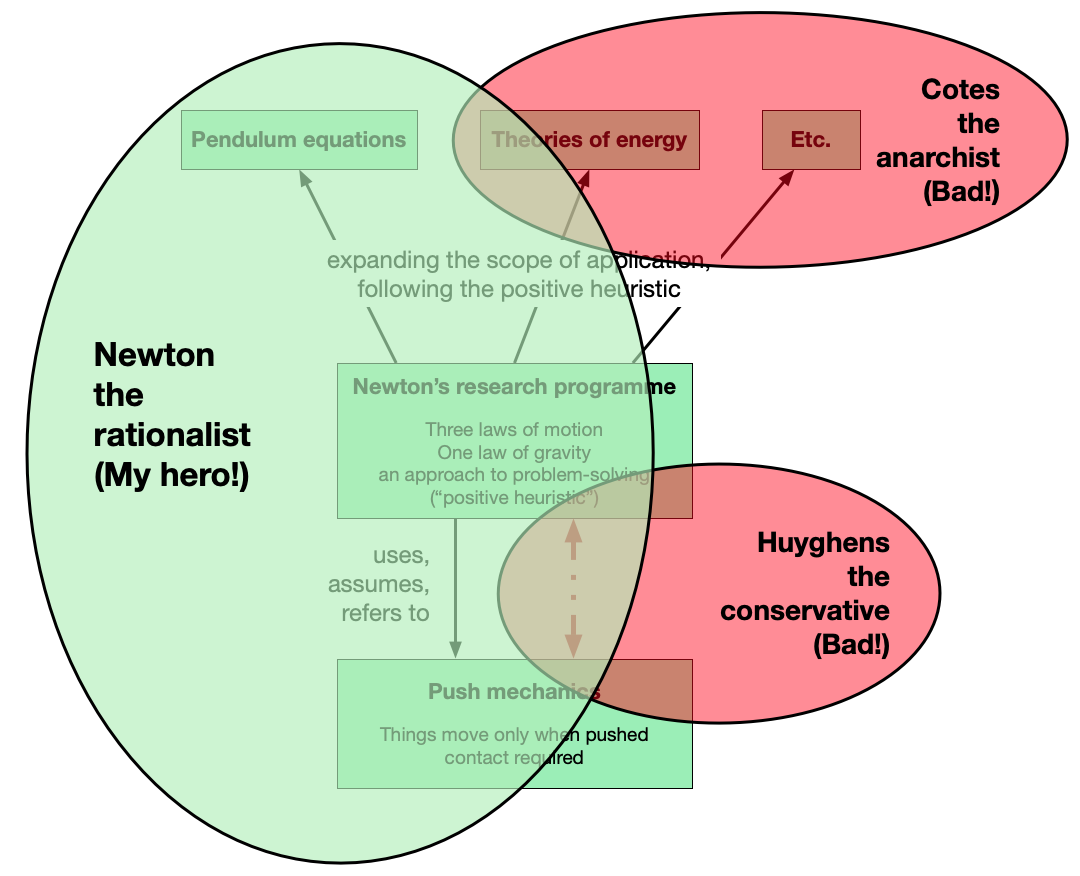
The rational scientist – Newton in this example – will do both. One who worries only about the inconsistency (Huyghens) is irrationally conservative. One who ignores the consistency (Cotes) is irrationally anarchist.
So I stand corrected: Lakatos did say Newtonian gravitation was instrumentalist, and his short history of the reaction matches (is a subset of) my longer one.
Poor Bohr
Newton is to be lauded because he worried about both foundations and extrapolations (went both “down” and “out”). Bohr behaved differently. Per Lakatos: Lakatos, Criticism, p. 141.
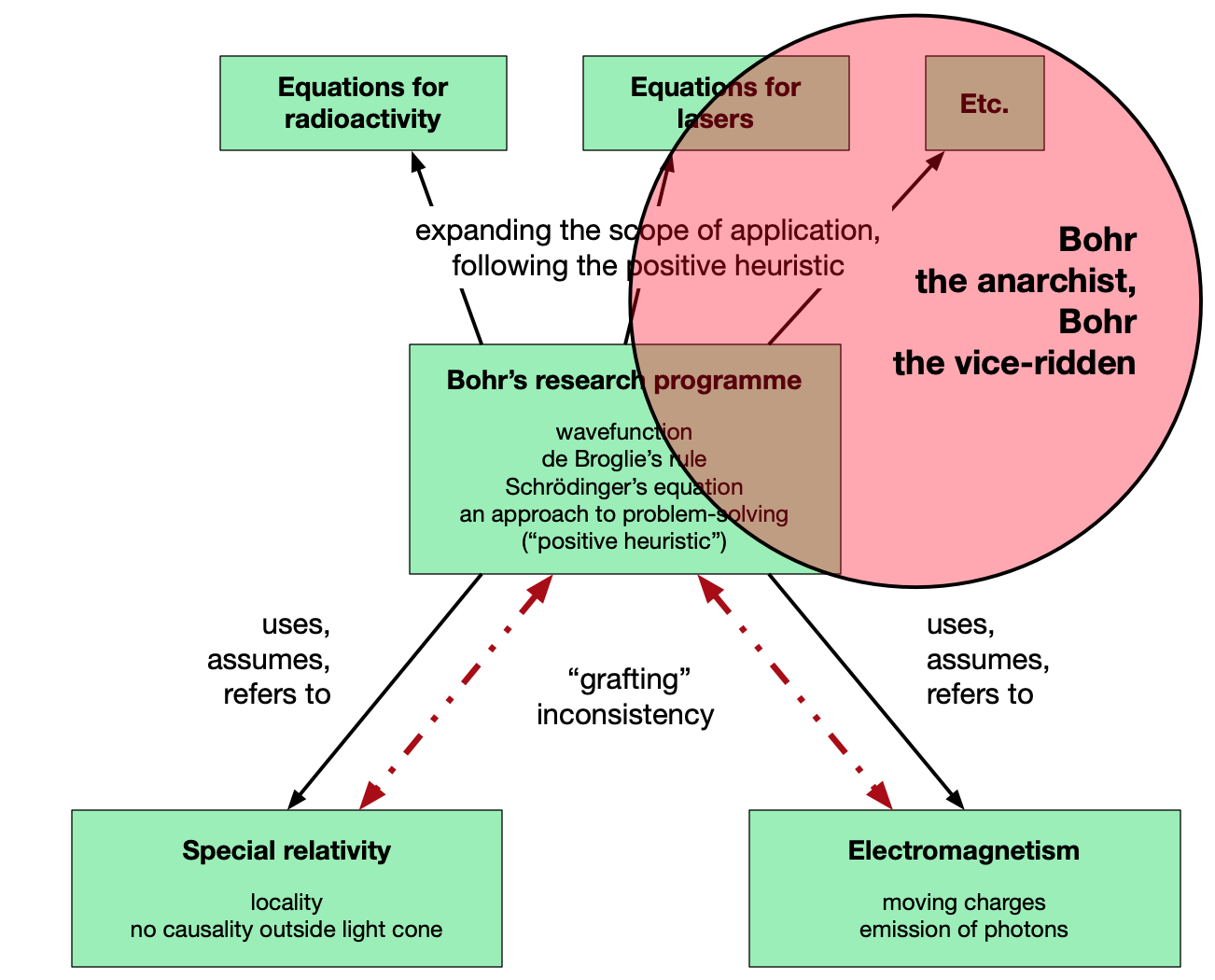
“The background problem was the riddle of how Rutherford atoms (that is, minute planetary systems with electrons orbiting round a positive nucleus) can remain stable; for, according to the well-corroborated Maxwell-Lorentz theory of electromagnetism they should collapse. But Rutherford’s theory was well corroborated too. Bohr’s suggestion was to ignore for the time being the inconsistency […]”
That worked, but too well: ibid., p. 142.
“It may well have been the success of his ‘grafted programme’ which later misled Bohr into believing that such fundamental inconsistencies in research programmes can and should be put up with in principle, that they do not present any serious problem and one merely has to get used to them. Bohr tried in 1922 to lower the standards of scientific criticism […].”
This was bad because: ibid., p. 143
“Consistency—in a strong sense of the term—must remain an important regulative principle […] and inconsistencies must be seen as problems. The reason is simple. If science aims at truth, it must aim at consistency; if it resigns consistency, it resigns truth.”
But wait
OK, so Newton was good, and Bohr was bad. But aren’t we supposed to be doing a methodology of science, not one of individual behavior? As I documented in the previous post, both Newtonian gravitation and quantum theory as fields of research – as collective human endeavors – behaved as Lakatos (and, elsewhere, Popper) said they should: some work was done applying the instrumental theory to new problems, and some was done on resolving the inconsistencies. See Maudlin’s Philosophy of Science: Quantum Theory Tim Maudlin, Philosophy of Physics: Quantum Theory, 2018. for many pages about the latter. Sure, a lot of that work was done after Lakatos died, but de Broglie, Bohm, and Everett are earlier. What are they? Chopped liver?
I’ve already pointed out that the critical rationalists look to history as a record of the deeds of the Great Scientists. I’ll put it more bluntly now. They care more about stanning Newton and Einstein than they do about the development of the theory of gravitation. And they care more about the moral status of Bohr than they do about the truths of the quantum world.
This interacts with their loathing of what they call “mob psychology.” Kuhn’s closing paper in Criticism and the Growth of Knowledge correctly (in my view) objects to calling the scientists who’ve actually made choices about theories a “mob”: Thomas Kuhn, “Response to my Critics,” in Criticism, p. 234.
“My critics respond to my views on this subject with charges of irrationality, relativism, and the defence of mob rule. These are all labels which I categorically reject, even when they are used in my defence by Feyerabend. To say that, in matters of theory-choice, the force of logic and observation cannot in principle be compelling is neither to discard logic and observation nor to suggest that there are not good reasons for favouring one theory over another. To say that trained scientists are, in such matters, the highest court of appeal is neither to defend mob rule nor to suggest that scientists could have decided to accept any theory at all.”
He thinks the expertise of the people doing the work matters more than a methodology from outside:
“My argument, however, goes even further, for it emphasizes that, unlike most disciplines, the responsibility for applying shared scientific values, must be left to the specialists’ group. It may not even be extended to all scientists, much less to all educated laymen, much less to the mob. If the specialists’ group behaves as a mob, renouncing its normal values, then science is already past saving.”
I agree with Kuhn, though I might extend the same authority to most – or all – disciplines.
The critical rationalists' scorn for Bohr seems to be because they view scientists unguided by philosophers as a mob. And, because it’s Great Men that matter, the mob must have a leader – someone responsible for its sins. That man was Niels Bohr.
I think they, in effect – not knowingly – used their methodology as a way to surreptitiously air their biases from behind the ever-so-respectable mask of “rationality.” They would no doubt disagree.