Immanuel Kant’s idea of “the manifold of sense” was, I think, a big deal in the late 1700s, but it seems obvious now. It figures in C.S. Peirce’s early philosophy, so I’ll devote an easily-linkable post to it.
Note: There is an annotated table of contents for this series.
An example
Dig, if you will, the picture:
Click to enlarge in a new tab.
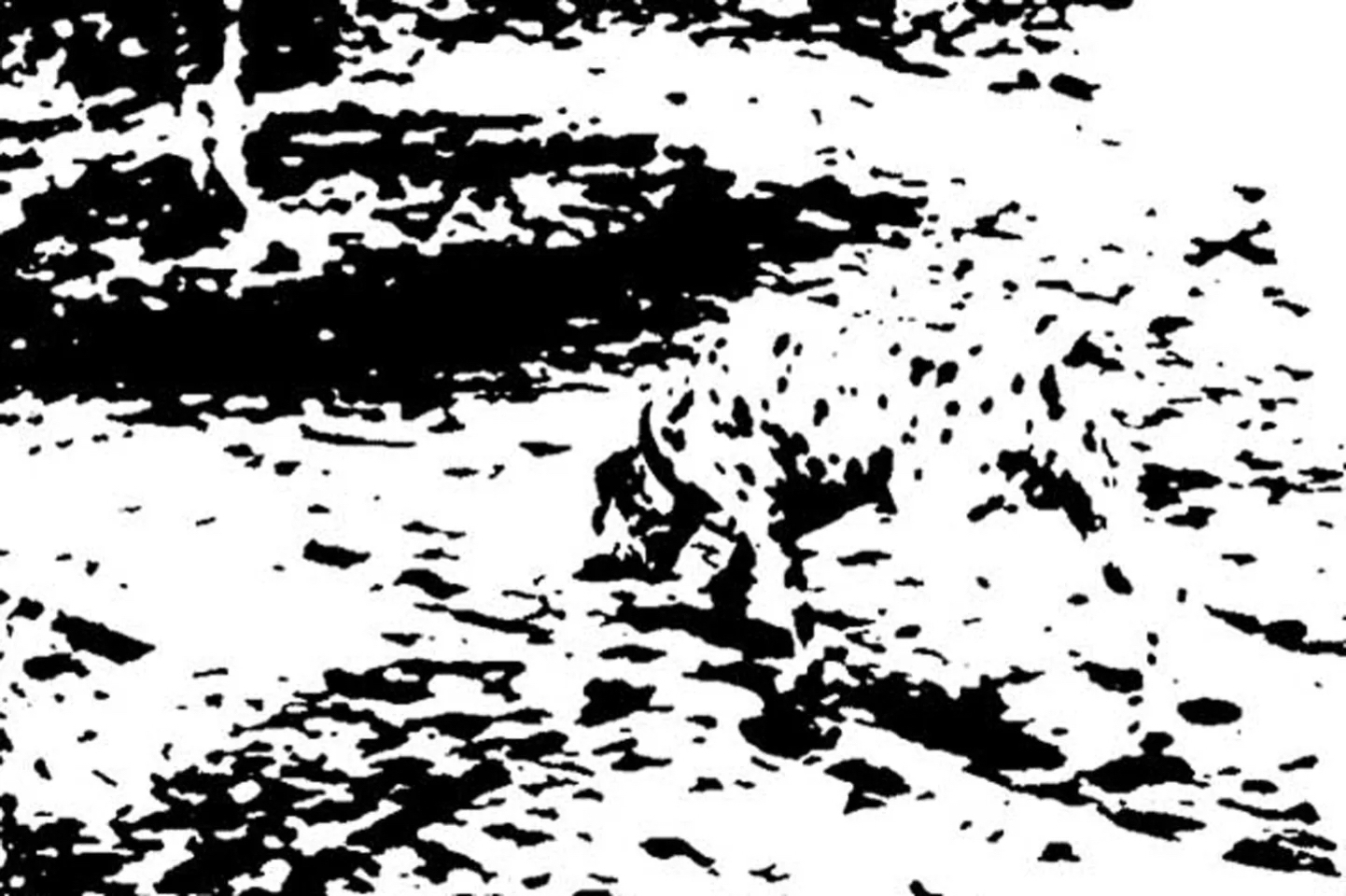
What is this a picture of? It may help to move back and view it from a distance. Alternately, these annotations might help:

I hope you now see a Dalmatian sniffing at the ground. If you’re like me, the Dalmatian is fixed in your mind and will pop out if you look at it a day from now, or quite likely a year from now. (It did for me, even though I’d misremembered it as being either a cheetah or a Holstein cow.)
The work you had to do to find the Dalmatian is a conscious version of the work your brain is doing all the time. The only difference is that the dog picture was intentionally distorted to remove the cues your brain normally uses to find discrete objects in the visual field, specifically edges and shading. That’s why, in the second image, I added lines to suggest where the missing edges were.
I also added the reference to “Head” as a gesture toward the predictive brain hypothesis. In that telling, the brain has certain hypotheses about what it will soon perceive. When possible, it favors checking its predictions over constructing a mental image from scratch. (The former is less work, and the brain is lazy.) I simulated such a prediction by telling your brain where to expect something that looks like a head.
Kant
Kant refers to the everyday blooming buzzing confusion of sensory input as “the manifold of sense” (or, sometimes, of “sensual impressions,” which I rather like). One of the mind’s jobs is to “reduce the manifold to unity.” That means converting a vague mass of colored areas into a list of objects that the brain can cogitate about in a rational way.
Kant seems to view the reduction of the manifold as instantaneous, action separate from any thought – no processing steps involved. Peirce treats it as a multi-step process of inference (which includes making hypotheses).
Peirce is closer to today’s neuroscience. He does have what seems to my modern eyes a bizarre fixation on a fundamental difference between mind functions that take place over time and those that are instantaneous. Given there aren’t any of the latter, I think his fixation was not useful.
Peirce’s early career seems to me partly a process of disentangling himself from Kant, so perhaps a lingering influence is to blame.