C.S. Peirce (1839-1914) was a logician, scientist, mathematician, and philosopher who was relatively unknown and under-published until well after he died. (But Bertrand Russell later wrote “he was one of the most original minds of the later nineteenth century and certainly the greatest American thinker ever.")
Peirce (pronounced “purse”) is most known for inventing philosophical pragmatism and its “pragmatic maxim.”
Because the pragmatic maxim is, I think, a heuristic more people should apply, I’ve decided to explain it by way of three anecdotes.
The anecdotes
I saw the pragmatic maxim in action when Ron Jeffries and I were on a joint consulting gig in California. It’s been more than twenty years, so I don’t remember the details, but it went something like this:
Cast your mind back to the earlyish days of Agile software development, before Agile had been corrupted into its present role as an excuse for micromanagement. Ron and I came from the Extreme Programming tradition, which had a shocking (for then and for today) emphasis on combining touchy-feely team autonomy with highly technical skills.
In those days, we faced a certain amount of skepticism (though for different reasons than why people today roll their eyes at the word “Agile”). We were at a meeting and one particular person wanted to argue for a claim about the nature of software engineering. Ron said something like, “Suppose I believed that. What would I do differently?”
In that case, the clear answer was: “nothing.” So Ron suggested that, if so, it didn’t matter whether he – or his counterparty – believed the claim or not, since none of us were being paid to decide on truths about software engineering, but rather to do the particular job of engineering some particular software.
Another example was when I was somewhere else in California. Two of us were working with an IBM employee to work on the testing portion of the Rational Unified Process, a very large collection of techniques and ideas about software development that, if adopted wholesale, would be fantastically cumbersome. Part of its selling point was that it could be refined (perhaps with IBM’s consulting help) to suit a particular company’s particular circumstances.
The other two people got into a discussion of the correct definition for a word – I think it was “plan.” Never one for definitional arguments, I sat that out. The discussion seemed to go on forever but it was probably somewhere between thirty minutes and an hour.
When they had finally come to an agreement. I said, “You both think you agree on the definition, but I guarantee you don’t.” I was shown to be correct when we tried to actually write some text to go in the process documentation.
Concrete use revealed problems in an abstract definition.
The psychologist and philosopher William James was a popularizer (and elaborator) of Peirce’s pragmatism, notably in his 1905 book Pragmatism: A New Word for Some Old Ways of Thinking. In it, he tells a story of a squirrel. It goes like this:
If you want to read his original version, it opens Chapter 2.
 Click to enlarge in a new tab.
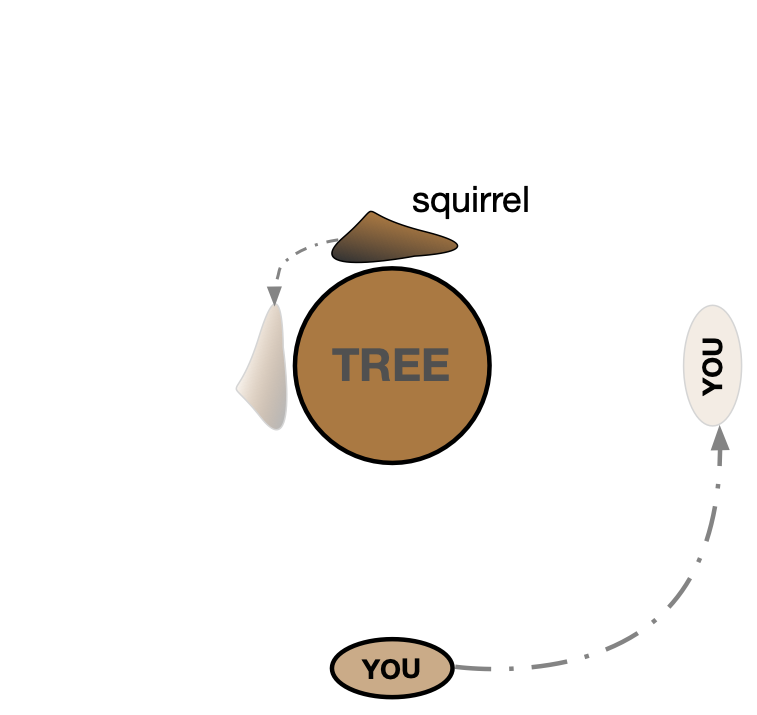
James was on a group camping trip. When he came back from a walk in the woods, the party was arguing about a common experience with squirrels. If you approach a squirrel that’s on the trunk of a tree, it will likely zip to the other side and peek out at you. If you start walking around the tree, it will shift its position so the tree is always between you. Suppose that you go completely around the tree before the squirrel gets bored and runs up the trunk into the canopy.
The argument wasn’t about whether you went around the tree – clearly you did – but rather about whether you went around the squirrel.
In James’s telling, the party was evenly split and they asked him for the deciding vote. Instead, he said the answer depended on what you meant by the phrase “around the squirrel.”
- If it meant that you had been to the south of the squirrel, then moved to the east of it, then to the north, then to the west, then back to the south, yes: you’d gone around the squirrel.
- If it meant that you’d been facing the squirrel’s belly, then one side, then its back, then the other side, then back to facing the belly, no: you hadn’t been around the squirrel because you’d always faced its belly.
“Although one or two of the hotter disputants called my speech a shuffling evasion, saying they wanted no quibbling or scholastic hair-splitting, but meant just plain honest English ‘round’, the majority seemed to think that the distinction had assuaged the dispute.”
Again, a question of meaning has been turned into a question of consequences, of perceptible actions in the world.
The pragmatic maxim
Suppose someone makes a claim like X is Y. Peirce says that is “a confused form of thought.” To think more clearly, you must ask “how would a rational person who believed that claim behave in some relevant situation S?”
As a heuristic, that means that evaluating a claim means transforming it into a series of statements of the form:
if a rational person believes claim C,
   and situation S holds,
then they should take action A
     (which they would not do if they denied C).
Is that implication true? Would they do A? If not, why should you believe the claim?
The more, and more usefully distinct, situations you consider, the better you understand a claim. Thinking of relevant and illuminating situations is a skill.
Meaning
If you could enumerate all situations, that list of if...then statements would exhaust the meaning of the claim. (Or so Peirce claims.) That is, there’s nothing useful to say about a claim that isn’t about future action. The “whole meaning” of the claim is in terms of human action in response to perceptible events.
If you want to get nit-picky, that’s impractical because both situations S and actions A can vary in an infinite number of ways. After all, you could change the name of a person in one situation to make it a new situation, and individual actions might differ only in silly little details. Do you have to enumerate all of them?
Some abstraction would be needed. You’d want some classification that lumped one infinity of situations into “Oh, that kind of situation” and the same for other infinities of situations. Similarly, you should abstract over actions so you don’t argue whether an action that Brian takes is different than one exactly the same except the person who takes it is Dawn.
Deciding what details to ignore is another skill.
For a perfect execution of the pragmatic maxim, it seems a lot of skill is required. But that doesn’t make it less useful as a heuristic. Perfection is not required for usefulness.
Two useful questions
The pragmatic maxim, as stated, is about belief in a particular claim. But it’s perhaps most useful when looking at contrasting claims:
- “Some people say
X is Y. Others sayX is Z. How would your future be different if you believed one versus the other? How would your behavior differ?”
Any answers might be useful. But there’s a special case:
-
“So you can’t identify any difference in behavior? Why are we even talking about whether
X is YorZ?”(We may be talking about it because they’re using
X is Yas a justification for what they’d be doing anyway for other reasons. I like to believe casting such subterfuge into sharp relief is valuable.)
Taking it to the limit
So a bunch of people have evaluated some subset of the possible consequences of believing X is Y and decided those are consequences they accept. Is that sufficient to say the claim X is Y is true?
Peirce says yes, in a particular sense. He hopes that if enough (rational) people evaluate the action-in-the-world consequences of X is Y, they will eventually converge to agreement that there are no more questions left to ask. All the scenarios and consequences anyone can think of to care about will have already been investigated. If there’s no further work to be done, why not say X is Y?
Peirce is content to wait for a very long time for that to happen. In the meantime, the enumerated consequences of believing X is Y will be useful in practical – pragmatic – terms. Some people will want to poke at the claim more, but the rest of us can poke at other, less researched claims. (Peirce, as a practicing scientist, was well aware of the opportunity costs of doing one experiment vs. another.)
The originals
The original statement of the pragmatic maxim comes from “How to Make Our Ideas Clear” (1878). The article is widely available. I copied the text from Philosophical Writings of Peirce, Justus Buchler (ed.), 2001. (archive.org) It reads:
“Consider what effects, that might conceivably have practical bearings, we conceive the object of our conception to have. Then, our conception of these effects is the whole of our conception of the object.”
A modern telling, from Wikipedia, is:
“If one were to accept, first of all, the conception as true, then what could one conceive to be consequent general modes of rational conduct by all who accept the conception as true? The whole of such consequent general modes is the whole meaning.”
Another statement from Peirce: In The Monist, April, 1905, p. 166.
“[T]he rational purport of a word or other expression, lies exclusively in its conceivable bearing upon the conduct of life.”