In late 1906, William James gave a series of lectures on the topic of a newly coalesced philosophical approach that had come to be known as “pragmatism.” His second lecture was titled “What Pragmatism Means.” It starts with a story that illustrates what you might call the “pragmatic temperament.” I try to have that temperament myself.
SOME YEARS AGO, being with a camping party in the mountains, I returned from a solitary ramble to find every one engaged in a ferocious metaphysical dispute. The corpus of the dispute was a squirrel – a live squirrel supposed to be clinging to one side of a tree-trunk; while over against the tree’s opposite side a human being was imagined to stand. This human witness tries to get sight of the squirrel by moving rapidly round the tree, but no matter how fast he goes, the squirrel moves as fast in the opposite direction, and always keeps the tree between himself and the man, so that never a glimpse of him is caught. The resultant metaphysical problem now is this: Does the man go round the squirrel or not? He goes round the tree, sure enough, and the squirrel is on the tree; but does he go round the squirrel? In the unlimited leisure of the wilderness, discussion had been worn threadbare. Every one had taken sides, and was obstinate; and the numbers on both sides were even. Each side, when I appeared therefore appealed to me to make it a majority. Mindful of the scholastic adage that whenever you meet a contradiction you must make a distinction, I immediately sought and found one, as follows: “Which party is right,” I said, “depends on what you practically mean by ‘going round’ the squirrel. If you mean passing from the north of him to the east, then to the south, then to the west, and then to the north of him again, obviously the man does go round him, for he occupies these successive positions. But if on the contrary you mean being first in front of him, then on the right of him, then behind him, then on his left, and finally in front again, it is quite as obvious that the man fails to go round him, for by the compensating movements the squirrel makes, he keeps his belly turned towards the man all the time, and his back turned away. Make the distinction, and there is no occasion for any farther dispute. You are both right and both wrong according as you conceive the verb ‘to go round’ in one practical fashion or the other.”
Although one or two of the hotter disputants called my speech a shuffling evasion, saying they wanted no quibbling or scholastic hair-splitting, but meant just plain honest English ‘round’, the majority seemed to think that the distinction had assuaged the dispute.
This is a catchy example, but it doesn’t spell out how James was using what he calls “the pragmatic method.” So let me do that.
Here is the key question James wants you to ask:
What difference would it practically make to any one if this notion rather than that notion were true? If no practical difference whatever can be traced, then the alternatives mean [in practice] the same thing, and all dispute is idle.
What new facts would flow from the knowledge that the human did or did not go around the squirrel? To answer that, we need to consider the already-known facts. We know the human went around the tree. We also know that he never actually saw the squirrel, as it also went around the tree. Moreover, having seen squirrels, we know it didn’t fly around the tree; rather, it did the usual squirrel thing of clinging to the tree and moving sideways to keep the tree between itself and a possible threat.
That given, there are two possibilities:
-
If we believed that the human did go round the squirrel, our attention might be drawn to the fact that he traversed the points of the compass. But we already knew that because everyone agrees he went around the tree, and the squirrel is on the tree.
-
If we believed he didn’t go around the squirrel, we’d know that he’d never faced the squirrel’s back. But we already knew that, too, because we know how squirrels work.
So the pragmatist’s answer to the question “did he go around the squirrel?” is: who cares? The dispute is idle. Echoing the Rorty of the previous post, we can say we would simply like to change the subject – which James persuaded his companions to do.
In sum, the pragmatic method is:
In what respects would the world be different if this alternative or that were true? If I can find nothing that would become different, then the alternative has no sense.
Action
In the above, I focused on what additional knowledge is gained from interrogating the concept “around” (none). But pragmatists tend to focus on action rather than facts. James quotes Charles Sanders Peirce: “our beliefs are really rules for action.“
Peirce’s last name is pronounced like “purse” rather than “pierce.” That’s annoying, which is fitting, as my impression is that Peirce was a pretty annoying person, to his detriment. Kind of an “alpha geek” character. Nevertheless, I cherish my Peirce teeshirt. (Click to enlarge.)
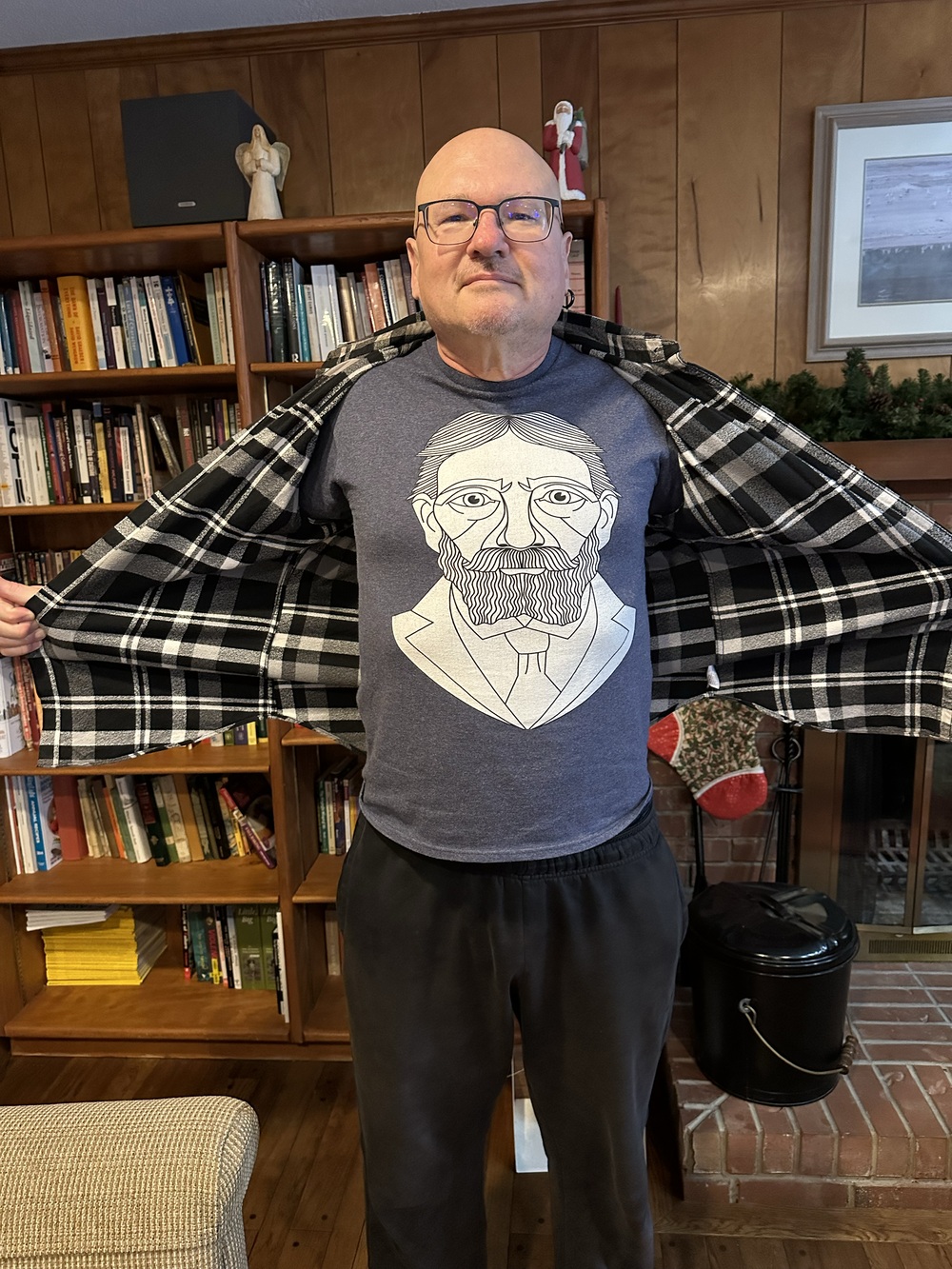
So the core question is “What would we do differently if we believed X than if we believed Y?” I once did a consulting gig with Ron Jeffries, and he asked that question when someone was arguing about the fundamentals of test-driven design (or something – it was twentyish years ago). The answer was, well, nothing, really, so we were able to move on.
We came out to the company about once a month for a year. On numerous occasions, Ron demonstrated the difference between knowing something intellectually (as I did) and having internalized ideas to the point of automatically having the right reaction. I learned a lot. Thanks, Ron!
Truth
Pragmatism recommends believing in something when human experience (yours and others) shows it to be useful. So when it comes to essentially contested concepts – ones where there’s disagreement about what a word or idea means – our take on which idea is correct should be that it’s the one that provides what James calls “cash value.” The value can be determined by discussion of consequences of putting the concept into action or, better, by seeing what happens.
The pragmatists were greatly influenced by Darwinian evolution (still rather new at the time), so let’s analogize concepts to species. Both change over time to better fit the environment they’re used in. So, if the woodland argument about “around” had revealed that one side or the other actually did reveal new concrete facts or suggest new and useful activities, the concept of “around” should be extended to include that.
Where the pragmatists got controversial was in saying that’s all you need. “Giraffes have long necks” is true because believing that has useful consequences. “Giraffes invariably speak in iambic pentameter” is false because someone who believed it is going to run into problems when, say, interacting with giraffes. And that’s it for our knowledge of giraffes: there’s no Platonic essence of “giraffe” out there somewhere that defines it independently of human experience. Or, if there is, it’s inaccessible to us, so it has no cash value.
Making true statements be relative to the mere humans that use them produces some strong reactions. In his History of Western Philosophy, Bertrand Russell ended his chapter on James thusly:
But this is only a form of the subjectivistic madness that is characteristic of most modern philosophy.
And the following chapter, on the roughly contemporaneous pragmatist John Dewey, ends:
I am persuaded that this intoxication [thinking truth is not independent of humans] is the greatest danger of our time [1945], and that any philosophy which, however unintentionally, contributes to it is increasing the danger of vast social disaster.
Not a fan, I sense. I avoid the issue by considering the pragmatic method a social approach that should be more used, and leaving capital-T TRVTH to others.
There are more practical problems with pragmatism. Darwinism has the advantage of a pretty straightforward way of determining if a mutation is useful: does it persist through generations? Over time, does a larger and larger proportion of the population have it? The question of the fitness of a belief is much harder. It’s easy to go down a recursive rathole. A belief is judged by its usefulness, but what does “useful” mean? Arguing about the definition of one essentially contested concept using other essentially contested concepts is a mug’s game. Still, I believe it makes a decent heuristic.
Anecdote
Around the time I was reading up on pragmatism, I was hired to work on the testing part of the Rational Unified Process. At a meeting of three of us, there was an extended discussion of the meaning of the word “plan.” Already a budding pragmatist, I did not participate but just waited for it to be over. The discussion seemed interminable, but was probably less than an hour, possibly as short as half an hour.
After the two agreed they had resolved their differences, I said, in my usual gracious way, “You both think you agree now, but I guarantee you don’t.”
I was right, as subsequent discussion showed.
However, I’m certain (given later events) that at least one person had his love for abstract argumentation affected not the tiniest bit. As Peirce put it, “It is hard to convince a follower of the a priori method by adducing facts.“ Charles S. Peirce, “How to Make Our Ideas Clear,” Popular Science Monthly 12 (January 1878). I give a link to a PDF below. But perhaps this little essay will give people with a pragmatic temperament a method with some cash value.
If you want to learn more
The Stanford Encyclopedia of Philosophy’s article on pragmatism is only a click away. It complicates the picture I sketched and includes later developments. As philosophical summary articles go, it’s quite readable.
Louis Menand’s The Metaphysical Club is a good first book to read. The Metaphysical Club was the group of people who more-or-less invented pragmatism. So you get descriptions of the key players and how they developed and used their ideas. In addition to discussing the influence of Darwinian evolution, Menand focuses on how the US Civil War left a lot of intellectuals leery of absolute truths and doubting the usefulness of certainty.
James’s Pragmatism: A New Name for Some Old Ways of Thinking collects his lectures. It’s short, readable (making allowance for the style of the time), and out of copyright. It does spend time on controversies and people that mean nothing to the non-philosopher audience more than 100 years later. It works well as an audiobook. (Though it’s not read by the author, alas.)
Louis Menand also edited Pragmatism: a Reader, which is a good collection of papers. It includes Peirce’s paper that kicked it all off: “How to Make Our Ideas Clear.” Peirce is not as easy a read as James, but you’ve surely read much worse.