As a philosopher of his time, Peirce was working in the shadow of Immanuel Kant (1724–1804). When writing to philosophers, Peirce could assume his audience was familiar with Kant’s theories.
With some exceptions, Peirce does a good job of making his own writing stand-alone, and I want my cover versions to be even more self-contained.
However. You get more from Peirce’s originals if you catch his allusions. For example, in the next essay, he argues that two concepts – space and time – are learned from experience. If you know Kant’s “the thing in itself” (Ding an sich), you’ll get a little frisson: “Oh ho! I know why he picked those particular two concepts. Bold!” – even though Peirce doesn’t mention Kant at all. You can get by without that, but it helps show where Peirce is heading: toward a completely different architectonic system than Kant’s.
So I toyed with writing occasional “music theory” posts to capture some background, something like how Kirk Hamilton, on his Strong Songs podcast, will refer to a pop musician using a Lydian chord to achieve a certain effect: you can enjoy the song without it, but you’ll enjoy it more when you know how the musician is working with a tradition – and why. While debating this, I happened to start rereading The Thing Itself (2016) by Adam Roberts. It’s a science fiction novel whose plot hook is “What if Kant got it right?” Early in the first chapter, Roberts gives a dandy explanation of Kant’s Ding an sich. So I’m going to quote it here, then I’ll add two more related short puzzlers.
The Thing Itself
Chaz and Roy are two British researchers alone in an Antarctic research base, the least noisy environment for astronomy. They’re there to search for signals of extraterrestrial life, to answer the Fermi Paradox: if there are aliens, why don’t we know about them?
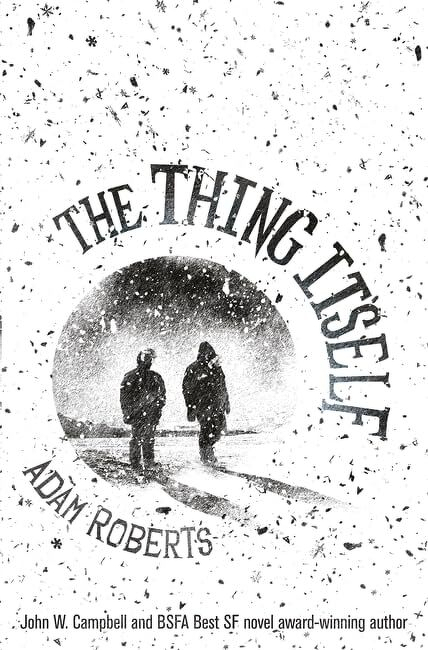
It turns out Roy has an answer worth testing. To celebrate his breakthrough, he breaks out a bottle of expensive whisky that he’s brought to Antarctica for such an occasion. He himself doesn’t drink whisky, though, only beer. Per Chaz: “This was about par, I thought, for the weirdo that he was – bringing a bottle of Scotch all the way to the end of the world, to not even drink it. I honestly didn’t care. I poured three fingers, and settled myself in one of the chairs.”
Our scene begins there.
I took another sip. ‘Congratulations!’
‘Thank you.’
‘And?’
He peered blankly at me. ‘What?’
‘And? In the sense of: what’s your solution?’
‘Oh. The Fermi Paradox.’ He sounded almost bored. ‘Well, I’ll tell you if you like.’ He seemed to ponder this. ‘Yeah,’ he added. ‘Why not? It’s Kant.’
‘Of course it is,’ I said, laughing. ‘You complete nutter.’ He looked hurt at this.
[…]
[Chaz] ‘Glad to hear it! But – Kant? Really?’
Roy took the smallest sip from his beer bottle, and then rubbed his chin with his thumb. ‘Hard to summarise,’ he said. ‘Start here: how do we know there’s anything out there?’
‘What – in space?’
‘No: outside our own brains. Sense data, yes? Eyes, ears, nerve-endings. We see things, and think we’re seeing things out there. We hear things, likewise. And so on. But maybe all that is a lie. Maybe we’re hallucinating. Dreaming. How can we be sure there’s anything really there?’
‘Isn’t this I think therefore I am?’
‘The cogito, yes,’ said Roy, with that uniquely irritating prissy inflection he used when he wanted to convey his own intellectual superiority. ‘Though Kant didn’t have much time for Descartes, actually. He says I think therefore I am is an empty statement. We never just think, after all. We always think about something.’
‘You’re losing me, Roy,’ I said, draining my whisky, and reaching for the bottle. Roy’s eyes flashed, and I stopped. ‘Do you mind if I have another?’
‘No, no,’ he urged me, bobbing forward and back in an oddly birdlike way. ‘Go right ahead.’
‘So,’ I said. ‘You’re saying we can’t be sure if the cosmos is a kind of hallucination. Maybe I’m a brain in a vat. So what? I’ve got to act as if the universe is real, or,’ I directed a quick look at Roy, ‘they’d lock me in the loony bin. So? Does this hallucination also include ET, or not?’
‘Quite right. Well, Kant says there is a real world – he calls it the Ding an sich, the thing as it really is. There is such a reality. But our only access to that real world is through our perceptions, our senses and therefore through the way our thoughts are structured. So, says Kant, some of the things we assume are part of the world out there are actually part of the structure of our consciousness.’
‘Such as?’
‘Quite basic things. Time and space. Causality.’
‘Kant is saying that time, space and causality aren’t “really” out there? They’re just part of our minds?’
Roy nodded. ‘It’s like if we always wore pink-tinted contact lenses. Like we’d always worn them, ever since birth. Everything we saw would have a pink tint. We might very well assume the world was just – you know, pink. But it wouldn’t be the world that was pink, it would be our perception of the world.’
‘Pink,’ I repeated, and took another slug. I was starting to feel drowsy.
‘We’re all like that, all the time, except that instead of pink contact lenses on our eyes, we’re wearing space-and-time contacts on our minds. Causality contacts.’
‘Space and time are the way the universe is. Just is.’
‘That’s not what Kant says. He says we don’t really know the way the universe just is. All we know is how our perceptions and thoughts structure our understanding.’
‘Wait,’ I said. ‘Kant says that cause and effect are just in our heads?’
‘That’s right.’
‘That’s nonsense,’ I said. ‘If space and time and causality are just inside my head, then what’s my head in? It takes up space, my brain. It takes time to think these thoughts.’
‘There’s something out there,’ Roy agreed. ‘But we don’t know what it is. Here’s a thought-experiment, Kant’s thought-experiment. You can imagine an object in space, can’t you?’
I grunted.
‘OK,’ said Roy. ‘And you can imagine the object being taken away. Yes? Then you have empty space. But you can’t imagine space and time being taken away. You can’t imagine no space, no time.’
I grunted again.
‘That shows that space, time, causality and some other things – they’re part of the way the mind perceives. There’s no getting behind them. Is the Ding an sich itself structured according to that logic? The eyeball cannot see itself. We cannot know. Maybe, maybe not.’
‘Ding,’ I said, my eyelids slipping down my eyeballs, ‘like a microwave oven?’
‘We’re looking for aliens with visual telescopes and radio telescopes,’ said Roy, standing up and putting his beer bottle down. ‘But whatever tools we use, we’re looking for aliens in space and time, aliens that understand causality and number. But maybe those things are not alien. Those things are the way our minds are built. And that means we’re looking in the wrong place. We should not be looking in space, or time. We should be looking in the Ding an sich.’
‘Sick,’ I said, My eyes were shut now. I didn’t seem to be able to open them. Such muscular operation was beyond my volitional control. ‘I feel a bit sick, actually.’
‘Ding,’ I heard him say, at the far end of a very long corridor. ‘You’re done. Let’s open the microwave door, now, shall we?’
Ding an sich
Ding an sich is sometimes translated “the thing in itself” or “the transcendental object.” It transcends the limits of empirical or sense-based observation or inquiry. Anything that can’t be known empirically but is nevertheless known is a priori or built-in knowledge.
The subject of thought
As Roy says, echoing Kant, “We always think about something.” That seems weird to me because I’m much more verb-oriented than noun-oriented, but it seems that philosophers from at least Aristotle on were focused on propositions, which are sentences all about a particular entity or subject:
<quantifier> <subject> is/is-not <predicate>
Hence, reasoning consists of manipulating sentences like:
- All men are mortal.
- Some polygons are squares.
- No animals are trees (or All animals are not trees).
All such sentences have an “aboutness” to them. They are pointing at a subject that’s presumably out there in the world. That something may be an individual (“that giraffe over there is…") or a “class” of individuals (Giraffes are animals with four legs.") You can play games with quantifiers. For example, “Socrates is mortal” can be rewritten “All people in the set ‘Socrates’ are mortal.” I’ve decided I don’t care.
This syntax and associated semantics dominated philosophy for centuries. For example, up until well into the 1800s, syllogisms were considered the way to capture how people reason. That is, all valid reasoning could be expressed in syllogism form. And all syllogisms required truth-claims to be in proposition form.
Boole (1816-1864) chipped away at the syllogism form by (in 1854) turning it into an algebra with operators like and and or – though he himself believed he was only putting the syllogism on a firmer grounding. It was De Morgan (1806-1871) who broke the syllogism (in 1860).
This is all happening in Peirce’s lifetime, so he was part of the transition from older logic to the ones we use today. But he didn’t necessarily start out a rebel, and his various essays need to be read as him trying to solidify his ideas during a time of rampant change.
The transcendental ego
Part of you is observable. Propositions can be made about you. You are an object it’s useful to call the-I.
That’s awfully mechanistic. It seems to us we’re more than just an observable object. Call that just plain I, or “the self,” or that which is distinct from what you and others think of the-I.
That is to say:
- A transcendental object cannot be captured by propositions.
- That is true of the self. Call that special case the transcendental ego.
- But when the transcendental ego observes the world, there are certainly perceptible entities to make propositions about – including propositions about the mind (the-I) doing the observing.
- So there is an I that is unknowable and a the-I that can be described.
We can think of the transcendental ego as the real self that interacts with the the-I to… well, do things like think and act in the world. My understanding is that Kant wanted there to be an I because his the-I couldn’t accommodate free will. (But he could only hand-wave about how the I could cause the the-I to produce effects in the world.) Early on, Peirce (it seems to me) accepted Kant’s dichotomy.